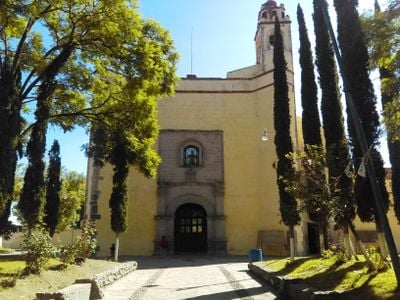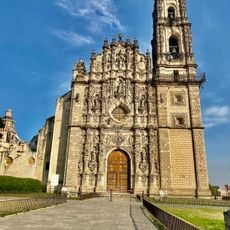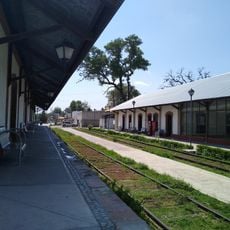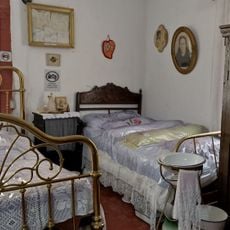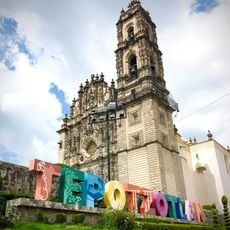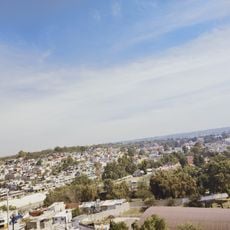
Templo y exconvento de San Francisco, UNESCO World Heritage convent in Tepeji del Río, Mexico.
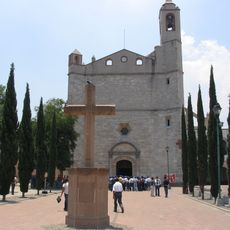
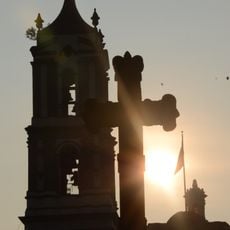
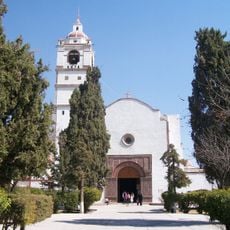
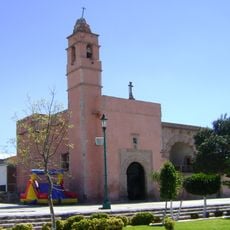
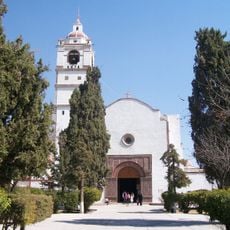
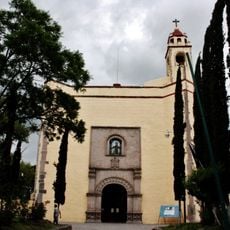
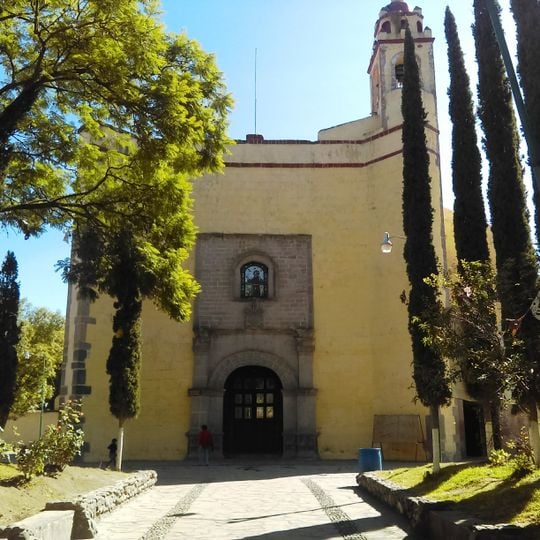
The Templo y exconvento de San Francisco is a 16th-century Franciscan church and former convent in Tepeji del Río. Its plain pale-yellow facade has a dark arched doorway inside a gray stone portal, with a single grilled window above; a bell tower with four bells and an octagonal drum rises on the right. The church has a rectangular nave with a barrel vault, and the complex, ringed by crenellated walls, keeps two posa chapels and an open chapel.
Fray Diego de Grado Cornejo began building the church and convent in 1560, and the complex was finished by 1586. The Acta de Xilotepec, drawn up in 1558 and 1559 before the viceroy Luis de Velasco, records the agreement between the towns of Tepeji and Utlaxpan to found it. The temple was secularized on 2 December 1768 but kept the name of San Francisco. In December 1816, during the War of Independence, the royalist Hevia attacked Juan de Terán, who held the convent with 200 insurgents.
The parish registers record the merging of the Nahua town of Tepexic and the Otomí town of Utlaxpan: the first baptism entered in Spanish alone dates from 1627, before entries returned to Otomí and Nahuatl until July 1643, when the priest himself wrote them in Spanish. The 1768 secularization kept the founding dedication to Saint Francis.
The religious complex remains active for Catholic services and offers guided tours through its spaces. Visitors should expect traditional opening hours and should dress respectfully when entering sacred areas.
In December 1816, the royalist commander Hevia attacked the convent with about a thousand men and artillery; the insurgent Juan de Terán held it with 200 men before withdrawing, abandoning only a few guns. The thick walls and buttresses that made this defence possible are still visible.
The community of curious travelers
AroundUs brings together thousands of curated places, local tips, and hidden gems, enriched daily by 93,761 contributors worldwide.