Our Lady of Guadalupe Sanctuary, Catholic sanctuary in Puebla, Mexico
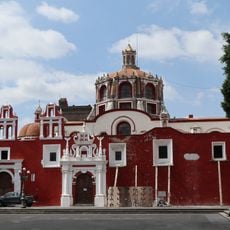
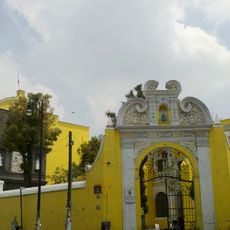
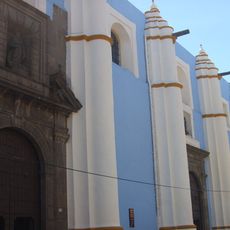
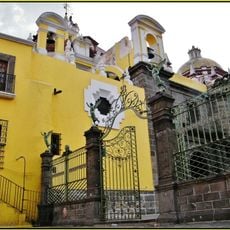
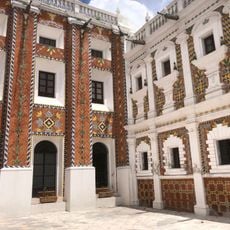
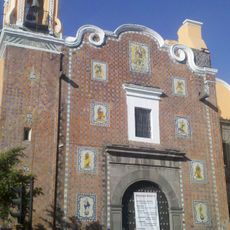
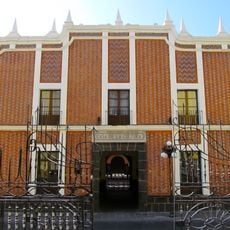
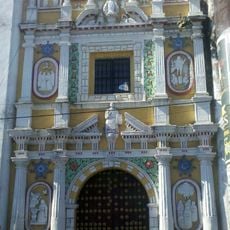
The Santuario de Nuestra Señora de Guadalupe, or La Villita, stands on Avenida Reforma facing Paseo Bravo. Its facade is framed by a blue-and-white talavera tile arch forming star patterns and bearing the monogram of Mary; red brick petatillo covers part of the front and the domes. Inside, a Latin-cross plan has a barrel vault with lunettes, and four canvases depict the Virgin's four apparitions.
In 1694 the blacksmith Juan Alonso Martínez de Peredo proposed building a temple to the Virgin of Guadalupe; the church was erected in 1714 and consecrated by the Cabildo Eclesiástico on 12 December 1722, with the facade designed by Diego de la Sierra. Another account credits Marcos de Madrigal with securing the land and funds. In 1765 the adjoining Colegio de Nuestra Señora de Guadalupe was built under Bishop Pantaleón Álvarez de Abreu with money from the widow of General Ortiz y Largachi. Sold for 6,400 pesos in 1870 under the Leyes de Reforma, the complex passed to the Guadalupan missionaries in 1903.
The name La Villita, by which the church is commonly known, refers to its role as a small shrine dependent on the parish. The facade tiles depict the four apparitions of the Virgin of Guadalupe, and the medallions carry the Latin phrase "fecit taliter omni nationi", authorized by Pope Benedict XIV when he proclaimed her patroness of New Spain. A chapel dedicated to the Virgin of Sorrows adjoins the temple.
The church faces Paseo Bravo on Avenida Reforma, formerly Calle de Guadalupe; the tiled and brick facade with its star-patterned talavera arch is the side to look for. It is an active Catholic sanctuary, so time a visit around services rather than assuming open doors, and dress modestly. A chapel dedicated to the Virgin of Sorrows adjoins the temple.
Look for the Latin inscription "fecit talliter omni nationi" ("He did nothing similar for any other nation") on the talavera medallions of the facade, beneath the bell towers. Pope Benedict XIV authorized this phrase for the image of the Virgin of Guadalupe when he named her patroness of New Spain. The same facade shows the four apparitions of the Virgin in tiles.
The community of curious travelers
AroundUs brings together thousands of curated places, local tips, and hidden gems, enriched daily by 93,762 contributors worldwide.