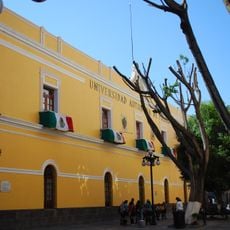
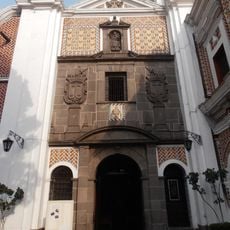
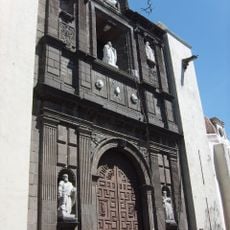
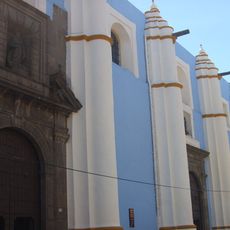
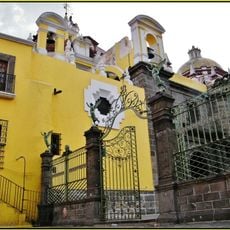
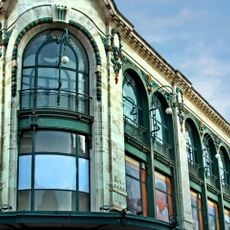
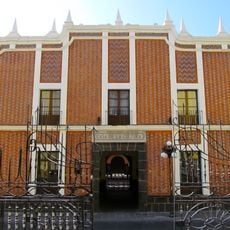
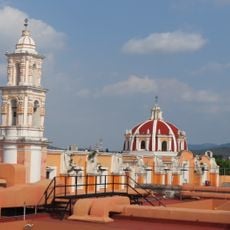
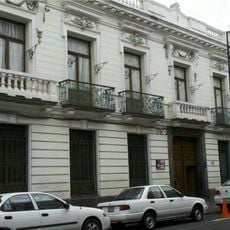
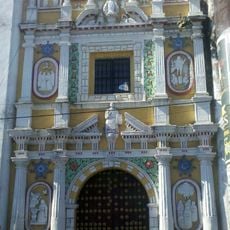
Patio de los Azulejos, Colonial courtyard in Puebla, Mexico.
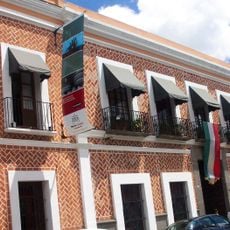
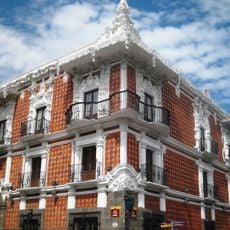
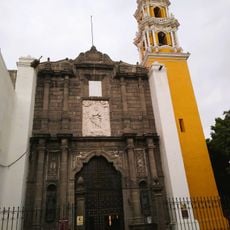
Patio de los Azulejos is an irregular-plan courtyard inside the former Casa de Ejercicios of the Oratorio de San Felipe Neri, at 11 Poniente 108 in Puebla's historic centre. Its facades mix brick, Talavera azulejo, piedra laja and plasterwork, with mouldings, balustrades, florones and pilasters whose shafts end in Doric capitals below and Ionic above. The common rooms rise higher than the cells along the east and south wings.
The Concordia church was rebuilt from its foundations in 1670 under Bishop Diego Osorio, directed by Florian Reynoso. From 1692 the San Felipe Neri oratory grew as a house of spiritual exercises, and between 1771 and 1790 Father Cayetano Medina expanded the Casa de Ejercicios to 36 rooms. Its press printed lottery tickets, the Plan de Iguala in 1816 and La Abeja Poblana, the city's first newspaper. The patio survived the 1856 siege of the Reform War undamaged.
The Talavera tiles covering the walls display traditional patterns in yellow ochre, blue, and green, reflecting regional craftwork and artistic values of the time. These colors were characteristic of how local artisans expressed their skills and identity through decoration.
The courtyard sits in a downtown area and is accessible to visitors without special preparation. You can explore the tile details and architecture on your own while examining the design of the various surfaces closely.
The Casa de Ejercicios press printed the Plan de Iguala in 1816 and later "La Abeja Poblana", the city's first newspaper; lottery tickets funded the house. Father Joaquín Furlong then sent a press to the independence forces.
The community of curious travelers
AroundUs brings together thousands of curated places, local tips, and hidden gems, enriched daily by 94,390 contributors worldwide.