Saffold Dam, Historic waterfall at Guadalupe River, United States
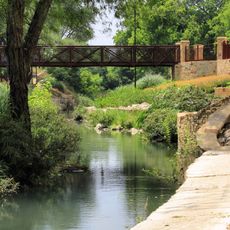
Saffold Dam is a historic structure on the Guadalupe River in Texas that creates a distinctive S-shaped waterfall formation. The construction spans several meters in both height and width, shaping how water flows across the landscape at this location.
Bird Saffold, William's father, bought the land in 1853 from Manuel N. Flores, a San Jacinto veteran and brother-in-law of Juan Seguin. William, a Civil War veteran, built a mill and store here in 1865 and added boulders to the natural rock ledge to power his gristmill. Henry Troell raised the dam for a cotton gin and installed hydroelectric generators in 1895; the City of Seguin bought the dam and power plant in 1907.
The crossing is named for Manuel N. Flores, who established a ranch on the south bank in 1838; German geologist Ferdinand von Roemer visited it in 1846 and described the ford's clear water in his 1852 book on Texas chalk formations. In the 1870s cattle herds crossed below the dam on the Saffold Crossing during drives north.
The dam is on the west side of Texas State Highway 123 Business, about ten blocks south of downtown Seguin. One bank borders Max Starcke Park and the city water works; the opposite bank holds the abandoned power plant. The impounded water behind it is the Max Starcke Reservoir, also called Lake Seguin or Lake Starcke.
The site is registered as a Paleo-Indian Archeological site and is the home of the Guadalupe Bi-face, a stone tool found here. Roughly 1,000 relics turned up in a single day of moving soil during routine yard maintenance, and an archaeological dig continues at the spot.
The community of curious travelers
AroundUs brings together thousands of curated places, local tips, and hidden gems, enriched daily by 92,780 contributors worldwide.