Hall of State, Art Deco museum building in Fair Park, Dallas, United States.
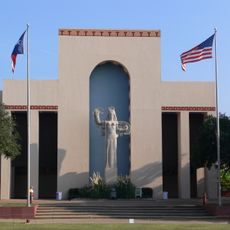
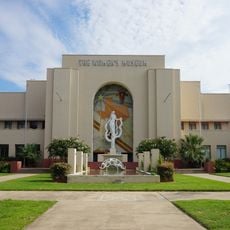
The Hall of State, originally the State of Texas Building, stands at the west end of Fair Park's 1,500-foot Esplanade of State. Donald Barthelme designed the T-shaped building, which opened for the 1936 Texas Centennial Exposition. Its curved entrance portico has 76-foot limestone pillars set before bluebonnet-blue tiles, and the bronze Tejas Warrior by Allie Tennant stands above the doors.
Built in 1936 for the Texas Centennial Exposition, it was one of the state's most expensive construction projects at the time. This major investment demonstrated how seriously Texans took preserving and presenting their state's past to future generations.
The Hall of Heroes, the semicircular entry hall, holds six bronze statues by Pompeo Coppini of James Fannin, Mirabeau B. Lamar, Stephen F. Austin, Sam Houston, Thomas Jefferson Rusk and William B. Travis, chosen by historians and the Centennial Commission. The exterior frieze carries the names of 60 figures from Texas history.
The Hall of State stands at the west end of the 1,500-foot Esplanade of State, flanked by six exhibition pavilions around a long reflecting pool. Enter through the curved exedra of the Portico Tejas, where 76-foot limestone pillars frame bluebonnet-blue tiles. The building is shaped like a T, with four regional rooms on the upper level and an auditorium, offices and archives below.
The front frieze lists 60 figures from Texas history, and the first letters of their names spell out the architect's surname, Barthelme. The bronze doors by Donald Barthelme carry lariats, cotton bolls, saw blades, pinecones and gushing oil rigs. Above the entrance, Allie Tennant's 11-foot Tejas Warrior holds a bow without an arrow, a symbol of peace.
The community of curious travelers
AroundUs brings together thousands of curated places, local tips, and hidden gems, enriched daily by 93,665 contributors worldwide.