Mazique Archeological Site, Archaeological site in Adams County, United States
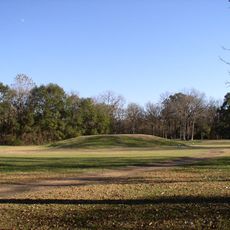
Mazique Archeological Site (22 AD 502), also known as White Apple Village, lies on the west bank of Second Creek in Adams County, Mississippi. It consists of three platform mounds and a central plaza. Mound A stands directly on the creek bank at 8 metres high, more than half its mass lost to erosion; Mound B, 4 metres high to the southeast, keeps its flat top and holds a historic cemetery. A third mound, reported only by Montroville W. Dickeson in 1841, is no longer located.
Mazique was occupied during the Coles Creek period (700–1000 CE) and the later Plaquemine Mississippian period (1000–1680 CE). In historic times it was the third and final site of White Apple Village, a Natchez town of the pro-English faction. Raiders from White Apple killed four French traders in 1716, and in 1729 the village's chiefs, ordered to vacate for a tobacco plantation, sent emissaries to the Yazoo, Koroa, Illinois, Chickasaw and Choctaw and to enslaved Africans, setting off the Natchez War.
The site reflects ceremonial practices and social structures that shaped life during two distinct periods of indigenous settlement. Visitors can observe how the arrangement of mounds and central plaza once organized community activities and gatherings.
The mounds stand on the west bank of Second Creek, a tributary of the Homochitto River, in southern Adams County. Mound A sits directly on the eroding creek bank, while Mound B lies to the southeast with a historic cemetery on its flat summit. The third mound described by Dickeson has not been located.
Mound B holds a historic cemetery on its summit, where graves were placed directly on the prehistoric earthwork. Mound A faces continuous erosion from Second Creek, making it a site where natural forces reshape the landscape year after year.
The community of curious travelers
AroundUs brings together thousands of curated places, local tips, and hidden gems, enriched daily by 93,974 contributors worldwide.