Alabama Museum of Natural History, Natural history museum in Tuscaloosa, United States.
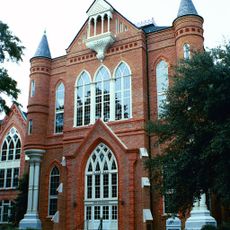
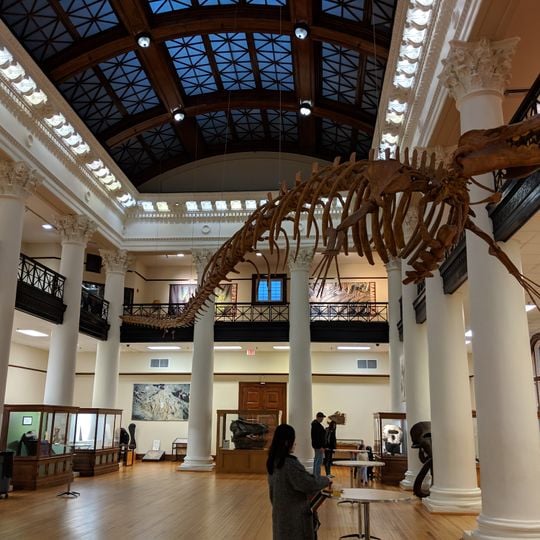
The Alabama Museum of Natural History occupies Smith Hall, a Beaux-Arts building on the University of Alabama campus in Tuscaloosa. Its three-story central block and two-story wings face the street with eight Ionic columns above a raised ground floor. Inside, a staircase of Alabama marble and Alabama-made iron leads to the Grand Gallery, ringed by Corinthian columns beneath a barrel-vaulted ceiling with skylights.
The museum was established in 1831, when the University of Alabama began gathering natural history specimens for research and teaching, making it the oldest museum in the state. Its present collections were built up from 1873, after geologist Eugene Allen Smith became state geologist and spent nearly forty years surveying and collecting across Alabama. Smith Hall, named for him, had its cornerstone laid on May 28, 1907, was finished in autumn 1909 and dedicated on May 5, 1910.
The Hodges meteorite, on display here, struck Ann Elizabeth Fowler Hodges in Oak Grove, Alabama, on 30 November 1954, the only known space object to hit a person. The museum's ethnology collections also cover Alabama's Indigenous peoples. Curator Herbert Huntington Smith built up specimens from 1910 until his death in 1919, and his wife Amelia Woolworth Smith, a collector, then served as acting curator.
The museum is located on the University of Alabama campus and is easy to reach. Visitors will find clear signage and should check current opening hours before visiting to make the most of their time.
The museum preserves important dinosaur fossils discovered in Alabama, including remains of prehistoric sea creatures. These findings come from when the region was submerged beneath a shallow inland sea.
The community of curious travelers
AroundUs brings together thousands of curated places, local tips, and hidden gems, enriched daily by 94,045 contributors worldwide.