Bynum Mound and Village Site, Archaeological site in Chickasaw County, Mississippi.
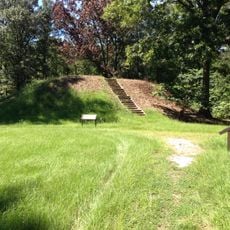
Bynum Mound and Village Site covers 6 hectares on a low ridge above Houlka Creek in the Tombigbee River drainage. It holds six conical burial mounds from 1.5 to 4.3 metres high, aligned in a row south of the associated village area. The two largest mounds were restored after National Park Service excavations in the 1940s.
Built and used between 100 BC and 100 AD during the Miller 1 and Miller 2 phases of the Miller culture, the site was excavated in the 1940s by National Park Service archaeologists, who opened five of the six mounds. Three mounds were dug during preparations for the Natchez Trace Parkway. The two largest mounds were later restored, and the site was listed on the National Register of Historic Places in 1989 as part of the parkway at milepost 232.4.
The site reveals evidence of far-reaching trade networks, with copper ornaments and greenstone tools showing connections to distant Native American groups. These objects demonstrate how communities across the region maintained contact and exchanged goods.
The site is located at milepost 232.4 along the Natchez Trace Parkway, making it easy to find and visit. Informational plaques provide explanations of the archaeological findings to help you understand the mounds.
Mound B, the largest at the site, covered a log-lined crematory pit. Inside, excavators found twenty-nine polished greenstone celts laid out in an L-shaped pattern, along with copper ear-spools, a piece of galena and nineteen chert projectile points thought to have come from Hopewell peoples in Illinois.
The community of curious travelers
AroundUs brings together thousands of curated places, local tips, and hidden gems, enriched daily by 93,031 contributors worldwide.