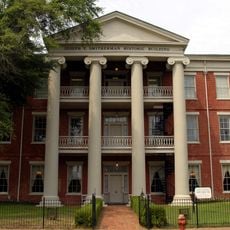
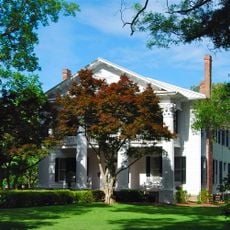
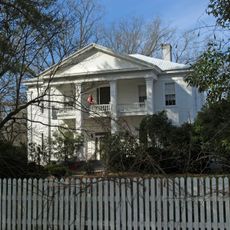
Sturdivant Hall, Greek Revival mansion in Selma, Alabama
This two-story brick mansion features six fluted Corinthian columns supporting an expansive front portico, with stucco exterior designed to resemble ashlar masonry and topped by a pyramidal roof with cupola.
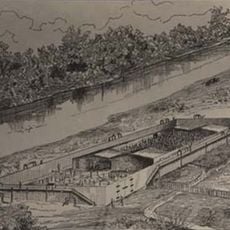
Construction began in 1852 and was finished in 1856 for Colonel Edward T. Watts, who sold the house to banker John McGee Parkman on February 12, 1864, for $65,000. Parkman, president of the First National Bank of Selma, was jailed after the bank's cotton speculation failed and was killed on May 23, 1867, attempting to escape from the Cahaba prison. The house was auctioned in January 1870 for $12,500 to merchant Emile Gillman, whose family kept it until 1957, when the City of Selma bought it for $75,000.
The house appears in Kathryn Tucker Windham's 1969 collection 13 Alabama Ghosts and Jeffrey; its story, "The Return of the Ruined Banker", tells of John Parkman's ghost returning after his 1867 death. The name honors Robert Daniel Sturdivant, whose $50,000 bequest helped the city buy the house in 1957 on condition that a museum be established.
The house is maintained by the City of Selma, Dallas County and the Sturdivant Museum Association. Visitors enter through the first-floor front doorway into an L-shaped hall with a cantilevered staircase; the second floor is reached by a further stair to an attic landing, then a spiral stair around a central pole up to the cupola.
Sturdivant Hall appears in Kathryn Tucker Windham's 1969 collection 13 Alabama Ghosts and Jeffrey, in a story titled "The Return of the Ruined Banker." It recounts John Parkman's ghost returning to the house after his death on May 23, 1867, during a failed escape from the Cahaba jail.
The community of curious travelers
AroundUs brings together thousands of curated places, local tips, and hidden gems, enriched daily by 92,854 contributors worldwide.