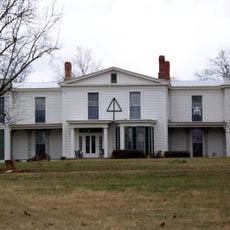
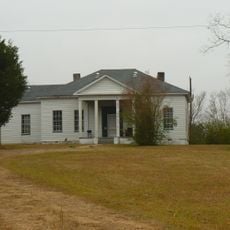
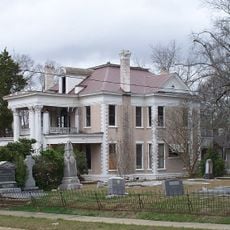
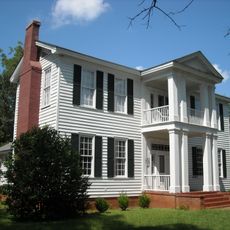
Kenworthy Hall, Plantation house in Marion, Alabama, United States
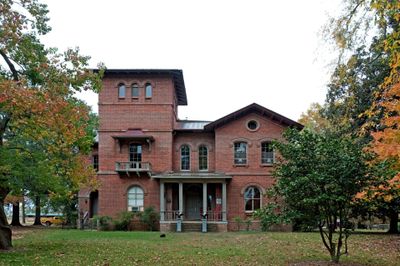
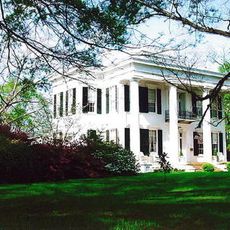
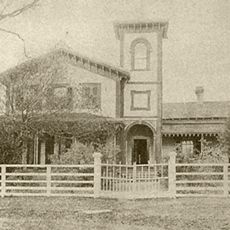
Kenworthy Hall is a brick plantation house on Alabama Highway 14, two miles west of the Marion courthouse square, built 1858–1860 to Richard Upjohn's asymmetrical Italian villa design. It has a massive four-story tower, windows of varied size and shape with brownstone trim, a wide cross hall at the rear, a detached kitchen and a full-width rear porch. The original standing-seam terne roof survives.
Edward Kenworthy Carlisle wrote to architect Richard Upjohn on 4 May 1858 requesting a plan for a country residence; master mason Philip Bond began work in November 1858, and the family moved in by 1860. After the Civil War Carlisle's taxable property fell below $20,000, and the house passed to his wife Lucinda in 1873, then to his daughter Augusta in 1899. It was declared a National Historic Landmark in 2004.
Kenworthy Hall reflects the craftsmanship and tastes of 19th-century Alabama landowners through its detailed interiors and carefully designed rooms. The house's brick walls, woodwork, and decorative elements show how owners of that era wanted to display wealth and refined living.
The house stands on the north side of Alabama Highway 14, two miles west of the Marion courthouse square, with four surviving ancillary structures on the grounds. The main entrance opens into a hall with a wide cross hall behind it, and a full-width rear porch faces the former estate. Three separate stairways serve the floors, including the tower rooms.
The detailed letters exchanged between Carlisle and architect Richard Upjohn reveal how meticulously the house was planned years before construction began. Circular saw marks on timber and large newel posts in the stairways show specific building techniques from that era.
The community of curious travelers
AroundUs brings together thousands of curated places, local tips, and hidden gems, enriched daily by 94,515 contributors worldwide.