Old Cathedral of Managua, Neoclassical cathedral in Managua, Nicaragua
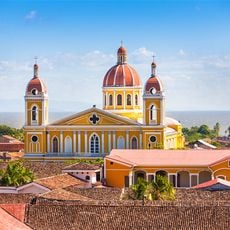
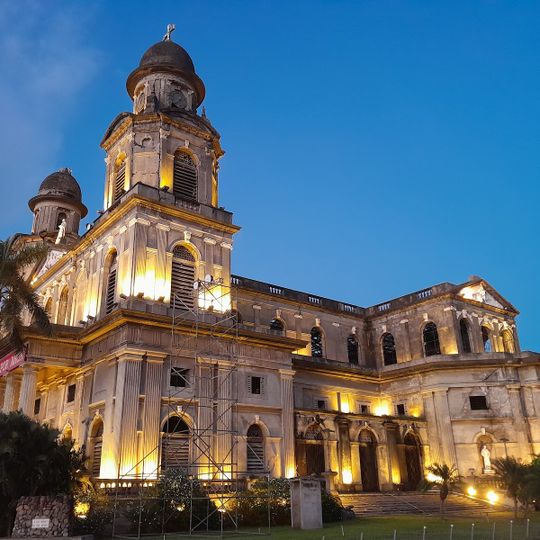
The Old Cathedral of Managua is a neoclassical building whose facade resembles the Church of Saint-Sulpice in Paris. Its iron framework was made in Belgium, shipped to the port of Corinto and carried by rail to Managua. It was the first building of its size in Nicaragua made of reinforced concrete, with Victorian, Renaissance and neoclassical elements.
The parish church on this site was rebuilt in 1783 under priest Juan Antonio Chamorro, with foundations laid by Tipitapa indigenous workers. In 1925 the first stone of a new cathedral was laid; Swiss engineer Pablo Dambach designed it after a Belgian church photo, and the iron frame arrived from Belgium via Corinto. Construction began in 1928, the frame withstood the 1931 earthquake, and the cathedral opened in 1938, consecrated in 1946. It was damaged in the 1972 earthquake.
The towers are consecrated to Saint Peter (north) and Saint Paul (south), and the central facade to the Saviour of the World. Life-size plaster statues by Granada sculptor Jorge Navas Cordonero stand outside, among them Isabella the Catholic, Columbus, Francisco Hernández de Córdoba, Bartolomé de las Casas and Fernando VII. The Somoza family kept a reserved place for Mass and Te Deum celebrations.
You can view the cathedral's exterior and look inside through protective iron bars, as structural concerns limit access to the building itself. It is best to explore the surrounding plaza area and photograph from outside to fully appreciate this landmark.
The cathedral's bells and clock were removed after the 1972 earthquake; the clock was taken to the Palacio Nacional de Cultura, today the Palacio de la Cultura. The towers themselves are consecrated: the north to Saint Peter, the south to Saint Paul, while the central facade is dedicated to the Saviour of the World.
The community of curious travelers
AroundUs brings together thousands of curated places, local tips, and hidden gems, enriched daily by 93,818 contributors worldwide.