New Smyrna Sugar Mill Ruins, Industrial ruins in New Smyrna Beach, United States
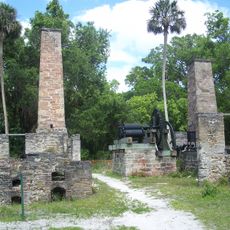
The New Smyrna Sugar Mill Ruins are remnants of a 19th-century sugar processing facility scattered across a large property. The surviving stone walls and structural fragments reveal how the factory once operated and what the industrial complex looked like when it was active.
In 1830, New York merchants Henry Cruger and William DePeyster hired William Kemble to build a steam-powered sugar mill and sawmill on 600 acres near New Smyrna, financed partly by Eliza Cruger. Enslaved laborers and draft animals, managed by overseer John Dwight Sheldon, ran the operation. On Christmas Day 1835, during the Second Seminole War, Seminoles burned the buildings; the West Point Foundry machinery was later moved to Dunlawton Sugar Mill.
The site demonstrates how early industry shaped the lives of many people who worked and lived here. Its remains reveal the economic connections that existed between factory owners, laborers, and those whose land was affected by this development.
The ruins stand at 600 Old Mission Road, about one mile west of the Intracoastal Waterway and roughly 2 km from New Smyrna Beach. The site lies on flat ground only about 2 metres above sea level, so the walk between the coquina walls is short and level.
The walls were built of coquina, a sedimentary rock of fossilized tiny mollusc shells quarried nearby. The machinery inside, made by the West Point Foundry of Cold Spring, New York, survived the 1835 fire mostly undamaged. The site was long misidentified as the ruins of the Mission of Atocuimi, a Spanish mission to the Timucua that never existed.
The community of curious travelers
AroundUs brings together thousands of curated places, local tips, and hidden gems, enriched daily by 93,036 contributors worldwide.