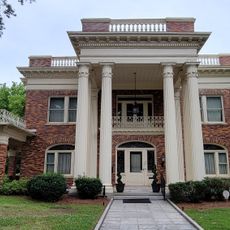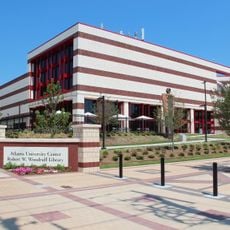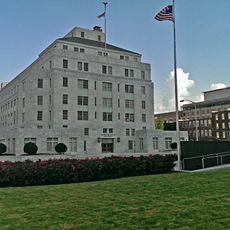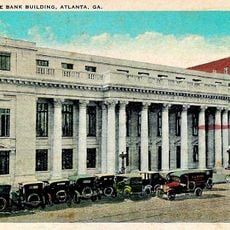
Fountain Hall, National Historic Landmark in Atlanta, United States.
Fountain Hall is a 3+1⁄2-story red brick building with a hip roof and a five-story tower above its recessed entrance, on the campus of Morris Brown College in Atlanta. Designed by Swedish-American architect G. L. Norrman in the High Victorian Gothic style, it was built in 1882 and is the oldest surviving building originally associated with Atlanta University.
Built in 1882 as Stone Hall, it served as Atlanta University's main building until 1929, when the university ended undergraduate education and deeded it to Morris Brown College. Morris Brown first called it Fairchild Hall, then Fountain Hall after Bishop William A. Fountain. W.E.B. Du Bois kept his office there from 1897 to 1910.
The building's names trace its history: Stone Hall until 1929, then Fairchild Hall, and finally Fountain Hall, after Bishop William A. Fountain of the African Methodist Episcopal Church, which founded Morris Brown College. From 1897 to 1910 the office of W.E.B. Du Bois was in the building while he taught at Atlanta University.
The building sits on the Morris Brown College campus and is easily visible from outside, with the clock tower serving as a clear landmark for orientation. Walking around the structure reveals different views of its brick facade and architectural details from multiple angles.
Fountain Hall was first renamed Fairchild Hall after being deeded to Morris Brown College in 1929, and only later took the name of Bishop William A. Fountain. W.E.B. Du Bois kept his faculty office in the building from 1897 to 1910.
The community of curious travelers
AroundUs brings together thousands of curated places, local tips, and hidden gems, enriched daily by 92,767 contributors worldwide.