Robert Barnwell Rhett House, Historic residence in Charleston, United States.
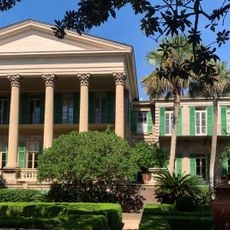
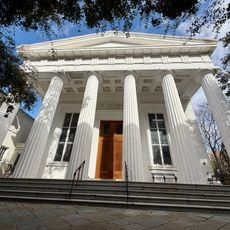
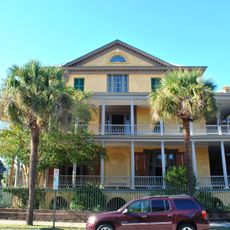
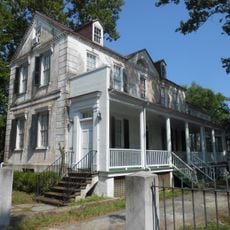
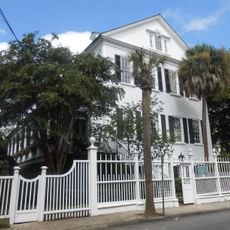
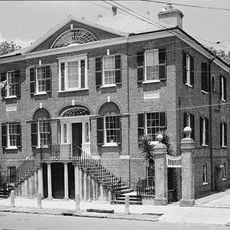
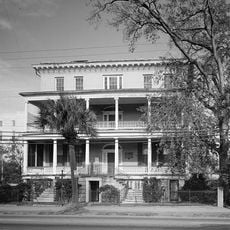
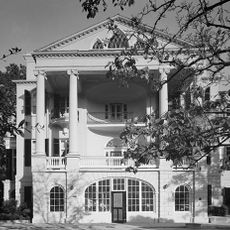
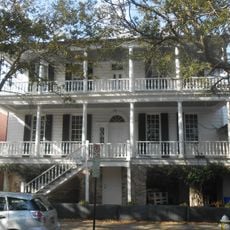
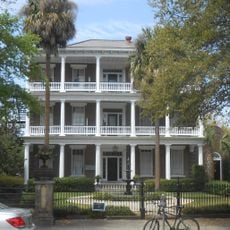
The Robert Barnwell Rhett House at 6 Thomas Street is a classical-style dwelling likely built by James Legare before 1856. It is a two-story house with a symmetrical facade and large decorative iron gates along Vanderhorst Street, one set of which remains locked shut.
The house was probably built by James Legare in a classical manner and sold in 1856 to Robert Barnwell Rhett, a leading secessionist who opposed John C. Calhoun in the Bluffton Movement over the Tariff of 1842. Rhett lived here until 1863, and his son, newspaper editor Robert Barnwell Rhett Jr., also occupied it. George Trenholm bought it in 1863, and the Hanckel family held it for about 70 years from 1867. It was declared a National Historic Landmark in 1973.
The house is tied to Robert Barnwell Rhett, a leading secessionist who opposed John C. Calhoun in the Bluffton Movement over the Tariff of 1842 and pressed for secession at the Nashville Convention of 1850. His son, newspaper editor Robert Barnwell Rhett Jr., also lived here. Along Vanderhorst Street, the western set of decorative iron gates is said to have stayed locked since a woman vowed not to reopen them until her fiancé returned from the Civil War.
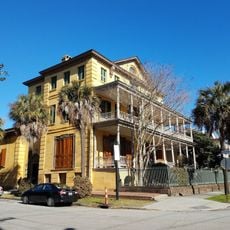
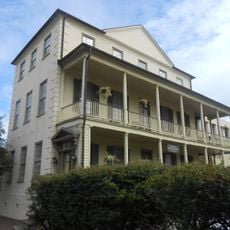
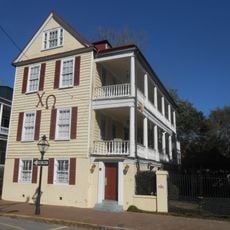
The house stands at 6 Thomas Street, at the corner with Vanderhorst Street, where the decorative iron gates face the sidewalk. It is a private residence and not open to visitors, so the exterior and the gates are seen from the street. The site lies within the Charleston historic district, walkable from the city's other historic houses.
The iron gates along Vanderhorst Street reportedly have remained locked since the Civil War according to local tradition. The story centers on a soldier who never returned to meet his waiting fiancee, and the memory persists in neighborhood lore.
The community of curious travelers
AroundUs brings together thousands of curated places, local tips, and hidden gems, enriched daily by 92,758 contributors worldwide.