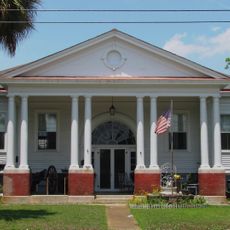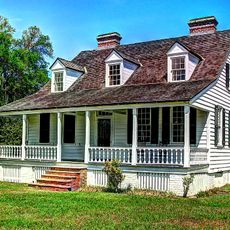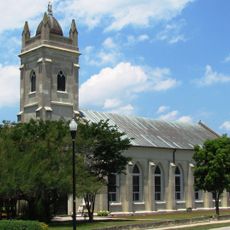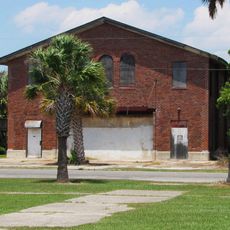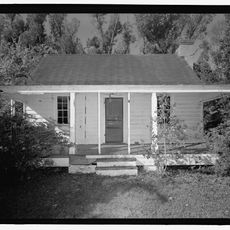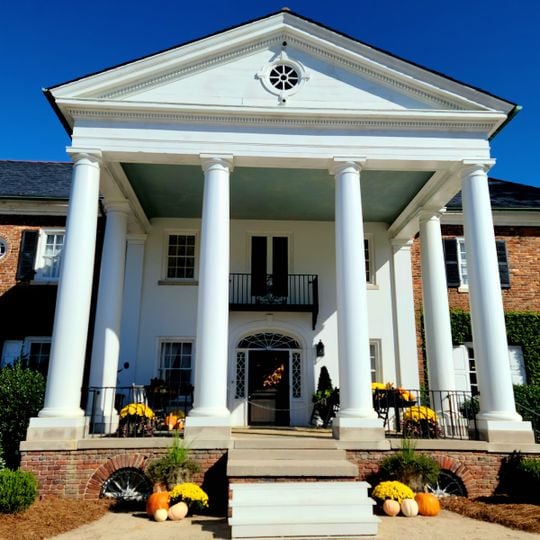
Boone Hall, Colonial plantation in Mount Pleasant, United States.
Boone Hall is a plantation in Mount Pleasant, South Carolina, with a 1936 Colonial Revival mansion of over 900 m². Its allée of southern live oaks, planted in 1843 by enslaved gardeners, leads to the house. Nine brick slave cabins with central fireplaces and a 1750 smokehouse also stand on the grounds.
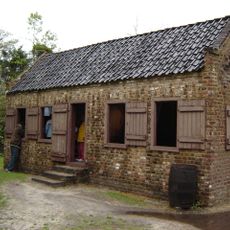
The site is first documented on 7 September 1681, when Theophilus Patey granted 470 acres to Major John Boone as a wedding gift on his marriage to Patey's daughter Elizabeth. The Horlbeck family later used enslaved workers to make bricks, producing 4 million by hand each year by 1850. Nine brick slave cabins survive and were inhabited until the early 1940s.
The name honors Major John Boone, who received the land as a wedding gift in 1681; his descendants later included Edward and John Rutledge, signers of the U.S. Constitution. The nine brick slave cabins now serve as exhibition rooms on slavery, and the site was named an African American Historic Place in South Carolina in 2009.
The site is open for public tours, and the nine brick slave cabins now serve as exhibition rooms on slavery. The plantation lies on the Wampacheeoone River, about 16 km from downtown Charleston and 7 km from central Mount Pleasant. The Avenue of Oaks runs more than a kilometre from the entrance to the house.
The Avenue of Oaks, over a kilometre long, was planted in 1843 by enslaved gardeners and field labourers using hand tools, under the direction of the Horlbeck family. The estate later served as the Mont Royal plantation setting in the television series North and South in 1985, 1986 and 1994.
The community of curious travelers
AroundUs brings together thousands of curated places, local tips, and hidden gems, enriched daily by 92,678 contributors worldwide.