Arizona Cactus Garden, Historic botanical garden at Stanford University, California.
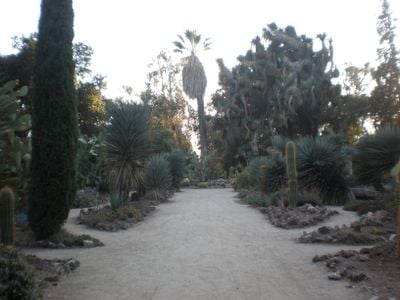
Arizona Cactus Garden is a 2,787 m² botanical garden on Stanford University's campus, near the Stanford Family Mausoleum. It holds about 500 cacti and succulents in 58 beds, split into an Eastern Hemisphere section of aloes and jade plants and a Western Hemisphere section of American cacti. A wide dirt path divides the grounds, with barrel cacti, yuccas and a tall palm among the plantings.
The garden was planted between 1880 and 1883 for Jane and Leland Stanford to a design by landscape architect Rudolph Ulrich, who specialized in "Arizona gardens" for drought-tolerant plants. It was meant to adjoin their future mansion, but after their only child died in 1884 the mansion was never built and the estate became Stanford University. Gardeners Chung Wah and Ah Wah kept it until they retired in 1925, after which it declined; volunteer restoration began in 1997 and continues.
The name "Arizona" here means arid, not the state: Rudolph Ulrich designed gardens for drought-tolerant plants. The two sections, Eastern and Western hemispheres, separate aloes and jade plants from American cacti. In the university's early years the garden was a favourite spot for courting couples.
The garden lies on the Stanford University campus, next to the Stanford Family Mausoleum and the Angel of Grief, and is open daily at no charge. As of September 2021 the plants carried no labels, so bring your own list of names. A wide dirt path divides the two sections, with the Eastern Hemisphere beds on one side and the American cacti on the other.
The garden was a favourite courting spot for Stanford students in the university's early years, and the two gardeners Chung Wah and Ah Wah tended the plants until they retired in 1925. Some 10 to 15% of the plantings still stand where they were set in the 1880s.
The community of curious travelers
AroundUs brings together thousands of curated places, local tips, and hidden gems, enriched daily by 92,771 contributors worldwide.