Stanford Mausoleum, Granite mausoleum in Stanford University Arboretum, United States.
The Stanford Mausoleum is a granite structure located within the university's arboretum, marked by Egyptian male sphinx statues at its front entrance and Greek female sphinx figures positioned at the rear. The building blends distinct artistic traditions within its stone design.
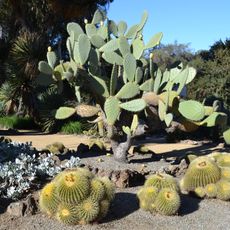
Completed in 1889 at a cost exceeding $100,000, the mausoleum was built after the Stanfords abandoned plans for a family mansion on this site; they had only planted a cactus garden, which still exists, before their son's death. The granite was quarried and dressed in Barre, Vermont, and shipped by rail for assembly, with white marble from Carrara, Italy. The architect is unrecorded and the design may have come from a monument company catalogue.
The cactus garden the Stanfords planted before their son's death still stands near the mausoleum. Beside it is the Angel of Grief, a 1908 copy of a 1901 copy of an 1894 statue by William Wetmore Story, marking Jane Stanford's brother Henry Clay Lathrop.
The mausoleum is opened to the public once a year, usually in October during the reunion weekend, when a wreath is laid as part of the annual Founders' Day activities. At other times it is not open to walk-in visitors. The site lies in the northwest of the Stanford University campus, within the arboretum, near the Angel of Grief memorial.
The female sphinxes now at the rear were originally placed at the front, but the Stanfords disapproved of their naked breasts and replaced them with Egyptian-style male sphinxes, moving the Greek figures to the back. The granite was quarried and dressed in Barre, Vermont, then shipped by rail for assembly, and white marble from Carrara, Italy, is also part of the structure.
The community of curious travelers
AroundUs brings together thousands of curated places, local tips, and hidden gems, enriched daily by 93,373 contributors worldwide.