Stanford University Arboretum, Botanical garden at Stanford University, California.
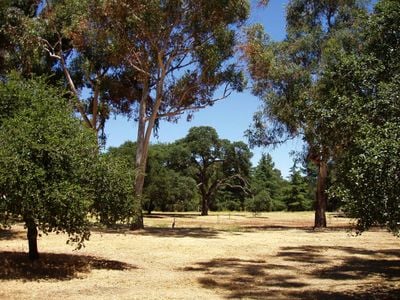
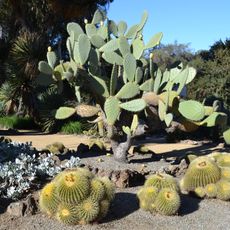
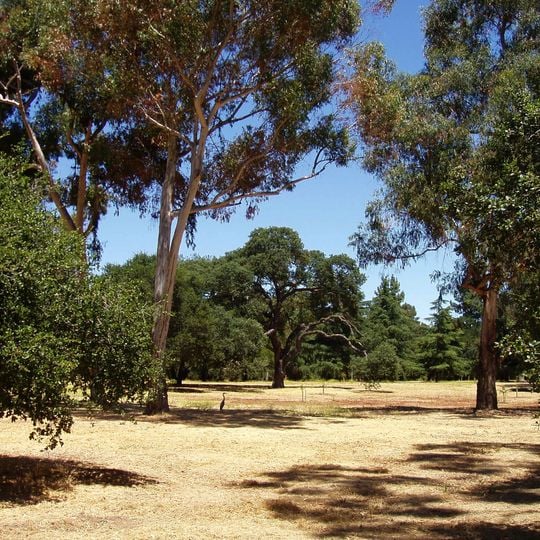
The Stanford University Arboretum covers open ground on the Stanford campus, where coast live oaks and other trees rise from dry, pale grass. At its peak the planting held over 350 species in 150 genera and sixty families, though the Olmsted Brothers reported in 1914 that it was mostly blue gums and Monterey cypress. The Arizona Cactus Garden and the Stanford Mausoleum stand within its bounds.
The arboretum grew from the live oaks on Leland Stanford's estate, which became the university campus. In 1885 Stanford hired landscape designer Frederick Law Olmsted to plan the grounds. An 1888 memorandum by Olmsted, signed by Stanford, combined the existing University Forest and the Arboretum, aiming to show the trees of the world that could mature there. Jane Stanford's 1903 address asked that no buildings ever be erected within the original Arboretum.
Jane Stanford's 1903 address to the trustees asked that no buildings ever be erected within the original arboretum and that it remain a park for drives and walks. The Arizona Cactus Garden and the Stanford Mausoleum stand inside its grounds. The coast live oak, the most common tree, descends from the live oaks on Leland Stanford's estate.
The arboretum is free to visit and offers shaded pathways that wind throughout the property. Wear comfortable shoes since terrain varies, and any season works well for exploring the different plant zones.
The collection holds around 51 eucalyptus species, a notable focus within this plant genus. This number reflects changes over time, as the grounds once contained many more of these Australian trees.
The community of curious travelers
AroundUs brings together thousands of curated places, local tips, and hidden gems, enriched daily by 92,932 contributors worldwide.