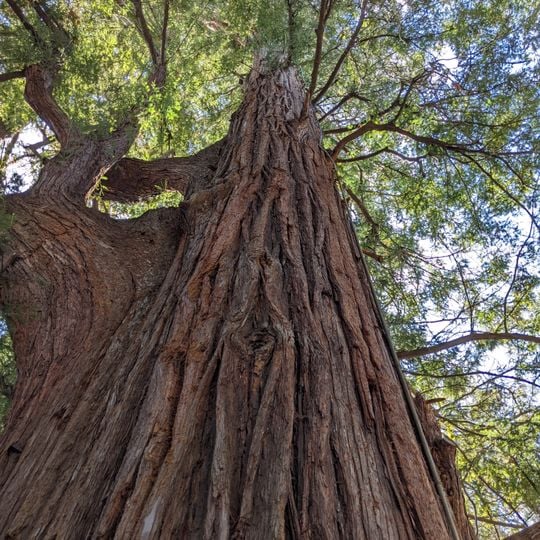
El Palo Alto, Coast redwood in Palo Alto, US
El Palo Alto is a coast redwood on the banks of San Francisquito Creek in Palo Alto, California, standing 110 feet (34 m) tall with a trunk diameter of 90 inches (2.3 m) and a crown spread of 40 feet (12 m). Its deeply furrowed bark is brown, grey, and reddish brown, and a single grey cable runs diagonally up the right side of the trunk, held by metal brackets. The base is broad and uneven, with gnarled woody growths near the bottom right.
El Palo Alto germinated around AD 940, when the Ramaytush-speaking Ohlone lived nearby at the village of Puichon. According to tradition, Gaspar de Portolá's expedition camped beneath it from November 6 to 11, 1769. The tree lost one of its two trunks before 1883, possibly through rainfall and bank erosion; Leland Stanford then had the riverbank reinforced.
The tree's Spanish name, 'the tall stick', gave Palo Alto its name. It appears on the city logo and the Stanford University seal, and a plaque at its base marks it as California Historical Landmark No. 2. The Ohlone village of Puichon stood nearby before European contact.
You can view the tree from a walking path that runs along San Francisquito Creek, and a small fence surrounds its site. The city maintains the grounds year-round, so visitors from all seasons get a good view of the redwood.
Scientists estimate that this specimen germinated around the year 940, making it more than a thousand years old. California granted it the status of the state's first named tree and oldest living historical landmark.
The community of curious travelers
AroundUs brings together thousands of curated places, local tips, and hidden gems, enriched daily by 92,790 contributors worldwide.