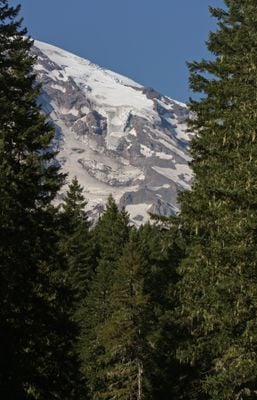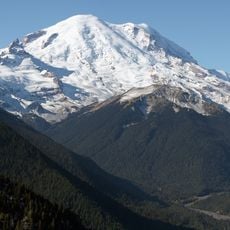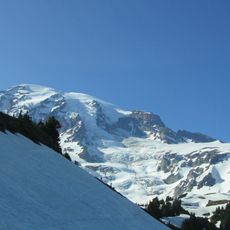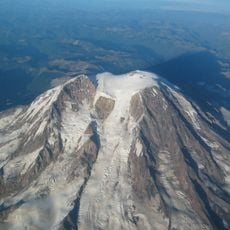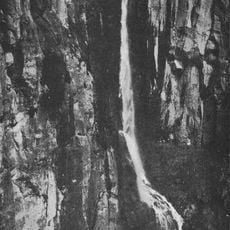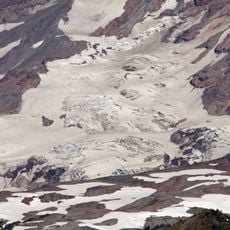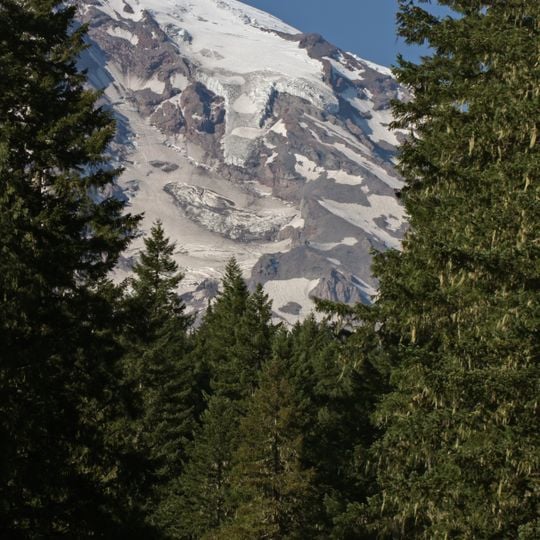
Kautz Glacier, Glacial formation on Mount Rainier, Washington, United States
Kautz Glacier is an ice formation on Mount Rainier that stretches from the summit ice cap down to the Kautz Ice Cliff at about 11,700 feet elevation. It flows through a narrow passage and provides a key route for climbers attempting the peak.
The glacier is named for August Kautz, sometimes credited with the first ascent of Mount Rainier. Its lower reach begins at the Kautz Glacier Headwall around 12,500 feet and flows south-southwest between the Kautz and Wapowety Cleavers. On October 2–3, 1947, heavy rain triggered a 40 million cubic metre mudflow that buried Highway 706 under 9 metres of debris; smaller flows followed in 1961, 1985 and 1986.
The glacier carries the name of August Kautz, an army officer sometimes credited with the first ascent of Mount Rainier. The Wapowety Cleaver, the rock rib beside the ice, is named for his Nisqually guide Wapowety. Climbers on the Kautz route pass Camp Hazard at 11,300 feet on that cleaver before ascending Kautz Chute.
This area is only accessible to experienced climbers and demands solid rope and crevasse skills. Visitors should rely on local guides familiar with the changing conditions and hazards on the mountain.
The October 2–3, 1947 mudflow carried boulders up to 13 feet (4 m) across and buried Highway 706 under 28 feet (9 m) of sediment. Deposits from that flow are still visible today. Smaller flows followed in 1961, 1985 and 1986; only the Nisqually, Winthrop and South Tahoma glaciers have produced similar ones on Mount Rainier.
The community of curious travelers
AroundUs brings together thousands of curated places, local tips, and hidden gems, enriched daily by 94,465 contributors worldwide.