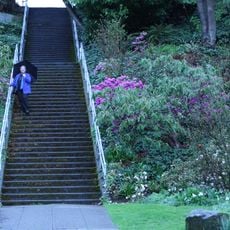
Seattle Japanese Garden, Japanese garden in Washington Park Arboretum, United States
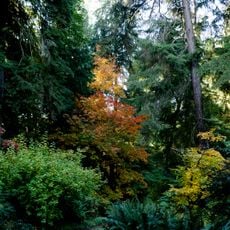
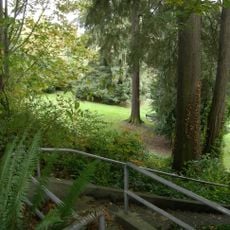
The Seattle Japanese Garden is a 3.5-acre (1.4 ha) garden at the southern end of Washington Park Arboretum on Lake Washington Boulevard East. Its layout combines a pond, gravel paths, traditional lanterns and wooden bridges with 600 short tons of granite boulders from Bandera Mountain, set among azaleas, rhododendrons, camellias, mosses and ferns.
A Japanese garden in Seattle was proposed as early as 1937, but construction waited until after World War II. In 1957 the Arboretum Foundation began fundraising, and designers Kiyoshi Inoshita and Juki Iida, chosen by the Tokyo Metropolitan Government, presented plans in 1958. Construction began in late 1959 using 600 short tons of granite boulders from Bandera Mountain, and the garden was dedicated on June 5, 1960.
The garden hosts Kodomo no Hi, Tanabata, Otsukimi moon viewing, Keiro no Hi and Momijigari maple viewing, with local calligraphers, taiko ensembles, dance troupes and traditional musicians performing. The teahouse, named Shoseian, was rededicated by Urasenke grand master Sen Sōshitsu XV in 1981.
The garden closes for several months in winter and otherwise opens from morning to sunset, with hours varying by season. It sits at the southwest corner of Washington Park Arboretum, and paths were modified in the late 1990s for wheelchair accessibility.
The teahouse, Shoseian, was a gift from Tokyo shipped in pieces in March 1959 and first used for a tea ceremony on July 4, 1959, led by Urasenke grand master Sen Sōshitsu XV. Vandals burned it in 1973; it was rebuilt by Yasunori "Fred" Sugita and rededicated in May 1981.
The community of curious travelers
AroundUs brings together thousands of curated places, local tips, and hidden gems, enriched daily by 93,237 contributors worldwide.