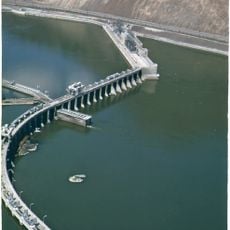
Columbia River Bridge, Cantilever bridge in East Wenatchee, United States.
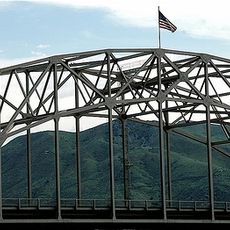
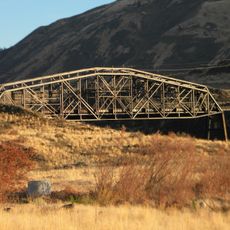
The Columbia River Bridge is a pin-connected cantilever truss of 1,600 feet (490 m) over the Columbia River between Wenatchee and East Wenatchee. A 200-foot Pratt truss hangs between two 160-foot cantilever arms, with 240-foot side arms and a 60-foot girder span. The east truss drops at a 6% grade toward its abutment, and a 60-foot girder span joins the level west truss. It now carries only pedestrians and cyclists, with an irrigation pipeline running inside the trusses.
Built between 1906 and 1908 by the Washington Bridge Company, it was the first road bridge over the Columbia south of Canada and carried U.S. Highway 2. Funding came from irrigation operators and Great Northern Railway founder James J. Hill. Fearing a toll, locals pushed the state highway board to buy it in 1911 for $182,000. After the Senator George Sellar Bridge replaced it in 1950, the Wenatchee Reclamation District bought it for $1.00 in 1951.
The bridge was renamed for irrigation canal builder William T. Clark in 2023, and its pipes now run inside the truss rather than outside. It is the only truss bridge of its type in Washington, listed on the National Register on July 16, 1982.
The bridge now carries only pedestrians and cyclists, as part of the Apple Capital Recreation Loop Trail; motor vehicles were diverted to the Senator George Sellar Bridge in 1950. The east approach keeps a 6% grade, so expect a slope on that side. Repairs in 2010 followed 2007 concerns about the structure's capacity for foot traffic.
The bridge connects Wenatchee and East Wenatchee while providing essential transportation links between Chelan and Douglas counties in Washington state.
The community of curious travelers
AroundUs brings together thousands of curated places, local tips, and hidden gems, enriched daily by 93,121 contributors worldwide.