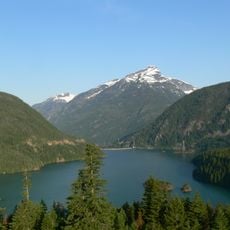
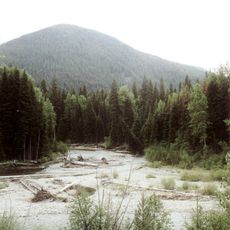
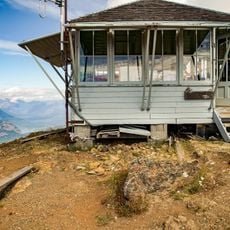
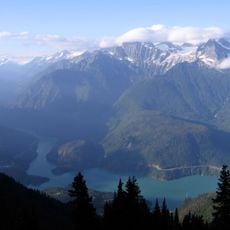
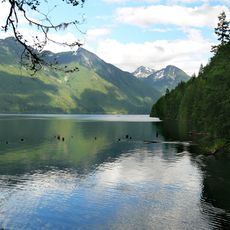
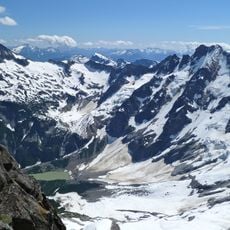
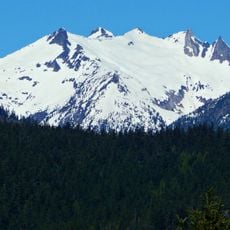
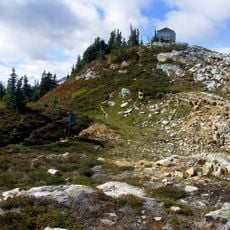
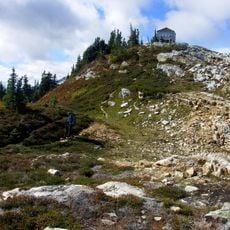
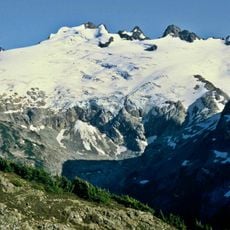
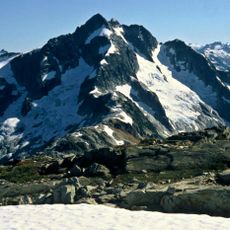
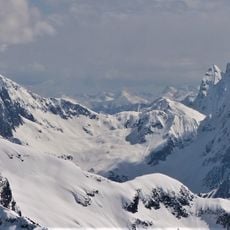
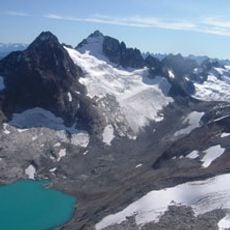
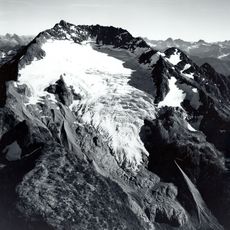
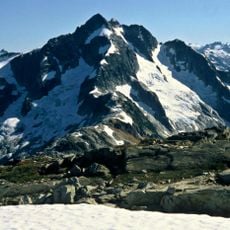
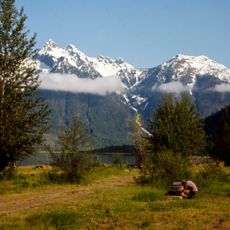
Hozomeen Mountain, Double summit mountain in North Cascades, Washington, United States.
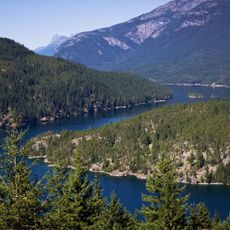
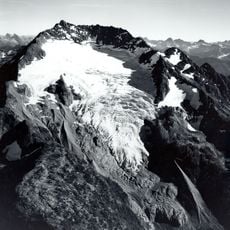
Hozomeen Mountain is a double-summited rock peak on the east side of Ross Lake in the North Cascades. The North Peak is the higher summit; the South Peak, at 8,003 feet (2,439 m), lies about 1 mile (1.6 km) southeast. The South Peak's north face is almost completely vertical for 1,000 feet, making it Washington's steepest peak with an average angle of 42.62° from the summit.
The North Peak was first climbed on September 6, 1904, by Sledge Tatum and George E. Loudon Jr. of the Boundary Survey, approaching from the northeast. The South Peak followed on May 30, 1947, via the Southwest Route by Fred Beckey, Melvin Marcus, Jerry O'Neil, Ken Prestrud, Herb Staley and Charles Welsh. The South-west Peak was first climbed in 1951 by John Dudra and Howard Rode.
The name Hozomeen comes from Salish and, according to native speaker Annie York, means "sharp, like a sharp knife." It appeared on a sketch map drawn by Thiusoloc, a Salish guide for topographer Henry Custer, during the 49th parallel boundary survey of about 1857–1860. The name links the peak to roughly 9,000 years of indigenous use of Hozomeen chert for tools.
There is no trail to either summit; all routes are class 3 to 5.10a rock climbs, and the Southwest Buttress and West Face are hard to protect with very few successful ascents. The easiest line, the North Route on the North Peak, is class 3-4. Access is from the east side of Ross Lake.
The mountain contains deposits of Hozomeen chert, a stone material that indigenous peoples used to make tools. These mineral resources made the location valuable for hunting and crafting activities long before European settlement.
The community of curious travelers
AroundUs brings together thousands of curated places, local tips, and hidden gems, enriched daily by 93,903 contributors worldwide.