Cowichan, Transport steamship in British Columbia, Canada
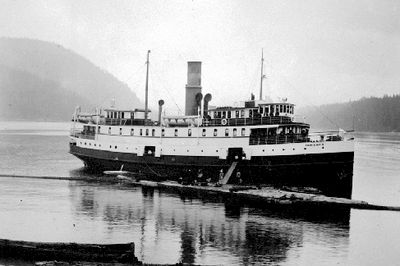
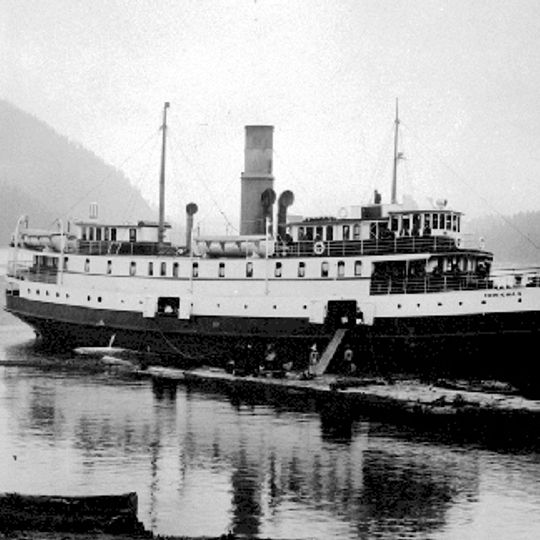
Cowichan was a 157-foot steamship built in 1908 in Troon, Scotland, by the Ailsa Shipbuilding Company for the Union Steamship Company. Its beam was 32 feet and its depth of hold 14 feet, with 962 gross and 520 registered tons. Twin triple-expansion engines by MacColl & Co. drove twin propellers at 11 knots, and two D. Rowan & Co. boilers were originally coal-fired.
The ship was built in 1908 by Ailsa Shipbuilding Company in Troon, Scotland. It sank after colliding with the Lady Cynthia in December 1925 near Roberts Creek.
The name Cowichan derives from the Halkomelem Q(a)w-(a)can, "warm mountains", thought to refer to hills at the head of the Cowichan River; the Cowichan First Nations lived on southeast Vancouver Island. Crew and passengers knew the ship simply as "The Cow".
Cowichan was built to reach inlets too narrow for larger vessels, such as Minstrel Island, Wells Pass and Kingcome Inlet. Its wheelhouse was enlarged and the bridge moved forward so the quartermaster and navigator could see over the bow. From Vancouver it sailed Mondays and Thursdays for Campbell River and Rock Bay, going further north to Loughborough Inlet on the Monday trip.
The ship's popular nickname was "The Cow", a shortening of Cowichan used along the coast. Its Canadian registry number was 126210, and the vessel carried separate cabins for First Nations passengers and for Japanese and Chinese passengers, with loggers housed apart as well.
The community of curious travelers
AroundUs brings together thousands of curated places, local tips, and hidden gems, enriched daily by 94,019 contributors worldwide.