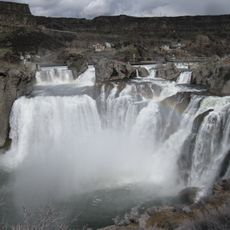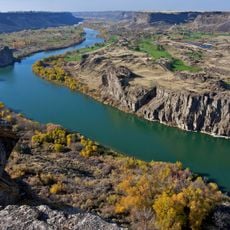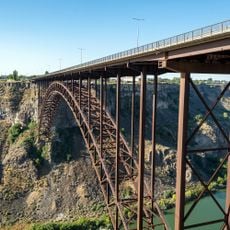
Milner Dam, Dam and hydroelectric power station on the Snake River, Idaho, United States
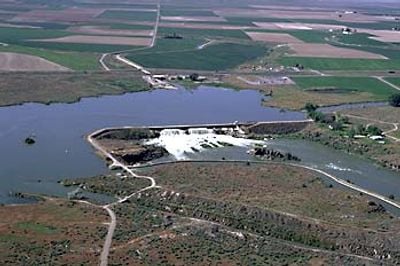
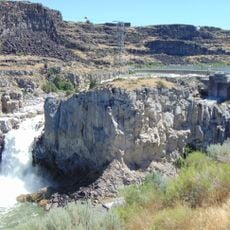
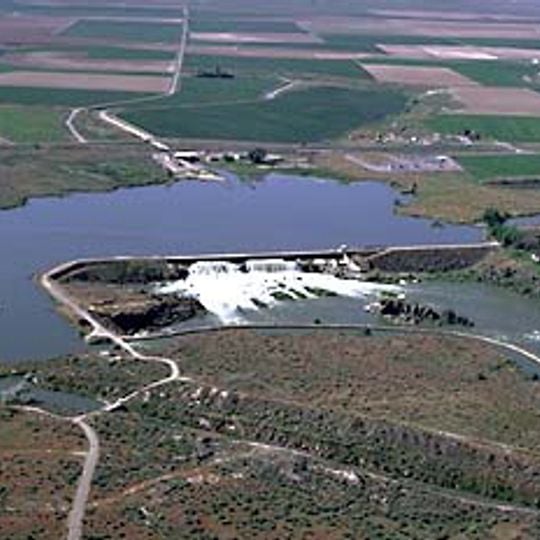
Milner Dam is a 73-foot-high, 2,160-foot-long rockfill dam across the Snake River, built in three embankments spanning two islands. Its crest carries a roadway broken by small structures, and at the center a white plume of spill water fans onto the riverbed. The dam impounds Milner Lake, a 4,000-acre reservoir holding 36,300 acre-feet.
Milner Dam was built in 1903–1905 by the Buhl-Kimberly Corporation under the 1894 Carey Act, after rancher Ira Burton Perrine chose the site and recruited investors Stanley B. Milner, Frank H. Buhl and Peter L. Kimberly. It was listed on the National Register of Historic Places on July 10, 1986. After 1988 inspections found a high earthquake failure risk, an $11 million rebuild was funded by an Idaho Power loan, and a 57.5 MW powerplant was completed 1.5 miles downstream in 1992.
Milner Dam has shaped how the local community and farms depend on controlled water for over a century. The structure shows how people reshaped their surroundings through practical engineering to grow crops and generate power.
The site sits in a quiet rural area between Jerome and Twin Falls counties surrounded by farmland and open fields. Visitors can walk along paths to view the structure and water flow from multiple angles, with terrain that is flat and easy to navigate.
The 1988 inspections found a high risk of failure in an earthquake, prompting an $11 million rebuild. To fund it, the operators contracted Idaho Power to build a 57.5 MW plant 1.5 miles downstream, opened in 1992 with 46 and 11.5 MW generators plus an 800 KW unit for low flow.
The community of curious travelers
AroundUs brings together thousands of curated places, local tips, and hidden gems, enriched daily by 94,474 contributors worldwide.