Caprock Escarpment, Escarpment on the Llano Estacado in Texas and New Mexico, United States
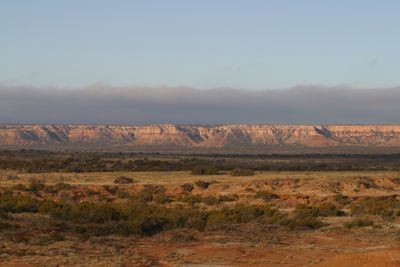
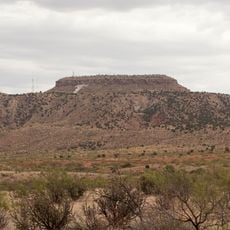
The Caprock Escarpment is a caliche layer of calcium carbonate that resists erosion, forming the eastern edge of the Llano Estacado. It runs about 200 miles south-southwest from the Texas Panhandle near the Oklahoma border, through Briscoe, Floyd, Motley, Crosby, Dickens, Garza and Borden counties, rising some 1,000 feet above the plains in places. Its face shows a pale tan and cream band with vertical striations and gullies, capped by flat rimrock above a reddish-orange slope.
The escarpment marks the eastern boundary of the Llano Estacado, a plateau crossed by the Comanche and earlier Plains groups; the name Llano Estacado, or staked plain, was given by Spanish explorers. Anglo settlement followed the cattle drives of the 1870s and 1880s, when ranches took up the grassland above the caprock. Caprock Canyons State Park, near Quitaque, opened in 1982, and its 65-mile trailway was added in 1992.
The name comes from "caprock", the hard caliche layer that caps the cliff and resists erosion. Caprock Canyons State Park and Trailway, near Quitaque, opened in 1982; its 65-mile trail, laid out in 1992, passes Clarity Tunnel, where a large colony of Mexican free-tailed bats roosts.
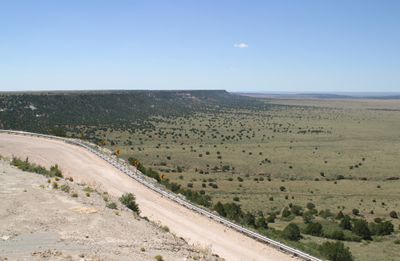
Interstate 40 crosses the escarpment between Adrian, Texas, and San Jon, New Mexico, where the road climbs several hundred feet. Caprock Canyons State Park near Quitaque, opened in 1982, holds a 65-mile trailway developed in 1992; Clarity Tunnel on that route shelters Mexican free-tailed bats. The cliff face is best seen from below, where the pale caliche rimrock stands above the red slope.
Clarity Tunnel, on the 65-mile trail in Caprock Canyons State Park near Quitaque, Texas, holds a large colony of Mexican free-tailed bats. The park opened in 1982 and the trailway was developed in 1992.
The community of curious travelers
AroundUs brings together thousands of curated places, local tips, and hidden gems, enriched daily by 93,786 contributors worldwide.