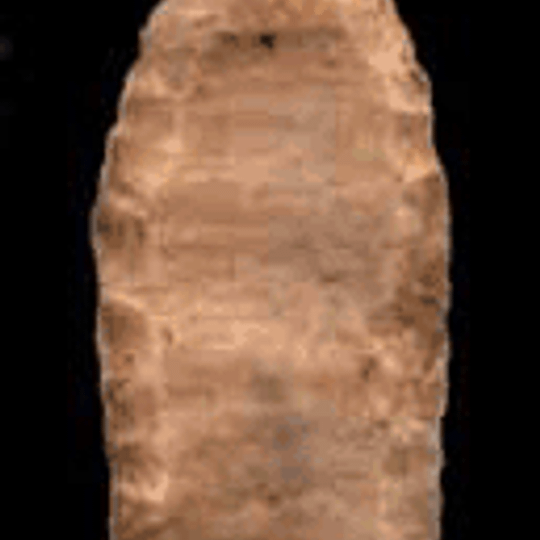
Folsom Site, Archaeological site in Colfax County, US.
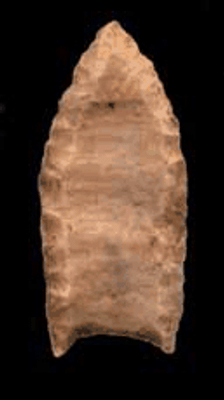
The Folsom Site, also called Wild Horse Arroyo, is an archaeological site about 8 miles west of Folsom, New Mexico, where a marsh-side bison kill and camp site was excavated in 1926. The arroyo bank yielded bones of 32 extinct bison and fluted Folsom points, including one found between two ribs.
George McJunkin, a formerly enslaved cowboy and foreman at Crowfoot Ranch, spotted large bones in Wild Horse Arroyo after the August 27, 1908 flood. In 1918 he and Ivan Shoemaker sent bones and a fluted point to the Denver Museum, prompting Harold Cook's 1919 visit. In 1926 Jesse Figgins found a Folsom point between two bison ribs, and the site became a National Historic Landmark in 1961.
The site gives its name to the Folsom tradition, defined by the fluted Folsom point found between two bison ribs in 1926. That point, still embedded in the bone, is displayed at the Denver Museum of Nature and Science. The site is on private land at Wild Horse Arroyo and is not developed for visits.
The site lies about 8 miles (13 km) west of Folsom, New Mexico, in Wild Horse Arroyo on the former Crowfoot Ranch. It is unexcavated ground with no visitor facilities, so plan for rough terrain and open weather. The original Folsom point, still set between two bison ribs, is displayed at the end of the Prehistoric Journey exhibit at the Denver Museum of Nature and Science.
The finds here show that hunters killed bison and used specialized tools that appeared across North America at the same time. This was among the first solid scientific proof that people lived on the continent during the Ice Age.
The community of curious travelers
AroundUs brings together thousands of curated places, local tips, and hidden gems, enriched daily by 93,848 contributors worldwide.