Fremont Pass, Mountain pass in central Colorado, United States.
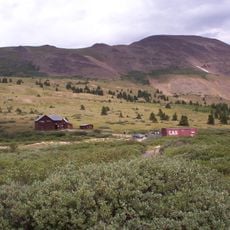
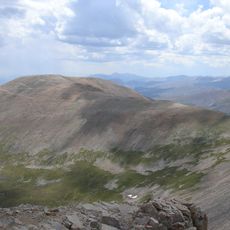
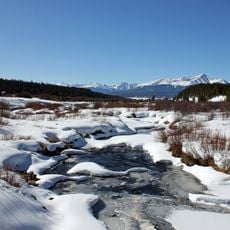
Fremont Pass is a mountain pass through the Rocky Mountains in central Colorado that spans several kilometers across high elevation terrain. It connects the areas around Copper Mountain and Leadville at approximately 3,450 meters and serves as a key transportation corridor through this rugged landscape.
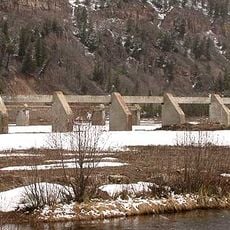
Fremont Pass is named for John C. Frémont, who found the route in the 1840s. Two narrow-gauge lines crossed it: the Denver and Rio Grande in 1881, whose passenger service ended in 1909 and which was abandoned on 1 December 1923, and the Denver, South Park and Pacific in 1884, sold in foreclosure in 1889 to the Denver, Leadville & Gunnison and later part of the Colorado and Southern, which ran until 1937. The line south of Climax was converted to standard gauge in 1943 and is now operated by the Leadville, Colorado and Southern Railroad.
The pass is named for John C. Frémont, who found it in the 1840s while crossing what is now Colorado. The name is shared with the surrounding Fremont Pass landscape, and the summit area is dominated by the Climax molybdenum mine, whose terraces and tailings are visible from Highway 91.
Fremont Pass is crossed by State Highway 91 between the Blue River valley and the Arkansas River headwaters. Apart from the switchback on the final climb toward the Climax mine on the south side, the grades are gentle. The Climax mine at the summit is an active molybdenum operation, so expect mine traffic and infrastructure along the top.
The Climax mine at the summit is not abandoned: ore was mined there until 1995, when operations stopped because extraction was unprofitable at world market prices. The Denver and Rio Grande's narrow-gauge line over the pass, by contrast, closed on 1 December 1923, after passenger service ended in late 1909.
The community of curious travelers
AroundUs brings together thousands of curated places, local tips, and hidden gems, enriched daily by 93,867 contributors worldwide.