Government House, Lieutenant Governor residence in Regina, Canada
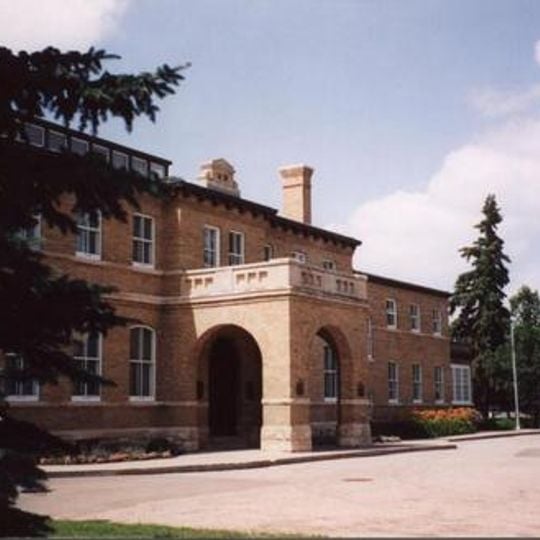
Government House is a two-storey tan brick and stone building in Regina, Saskatchewan, designed by Dominion architect Thomas Fuller in the Italianate style and completed in 1891. Its central entrance porch sits behind a stone balustrade above a round brick archway, with a second round arch to the right; a square chimney and small gabled cupola rise above the entrance bay. It is the official office of the lieutenant governor of Saskatchewan.
Government House replaced an 1883 prefabricated wooden residence that stood five blocks west until its demolition in 1908. Designed by Dominion architect Thomas Fuller in an Italianate style, the brick and masonry building was begun in spring 1889 by local contractor William Henderson and completed in 1891 at a cost of $50,000, the first electrified residence in the Territories. It housed lieutenant governors of the North-West Territories and, from 1905, of Saskatchewan until it was vacated in 1944; it returned to ceremonial use in 1984.
Government House was the workplace and residence of the lieutenant governors of the North-West Territories from 1891, and of Saskatchewan from 1905. It received royal guests: the Duke and Duchess of York in 1901, and the Duke of Connaught, who opened the Saskatchewan Legislative Assembly in October 1912. Vacated in 1944, it returned to official ceremonial use in 1984.
Government House stands on Dewdney Avenue, the street named for Lieutenant-Governor Edgar Dewdney, east of the Wascana Creek area. The building is a national historic site and provincial heritage property, so access to the interior is by guided tour rather than self-guided wandering. The 1883 predecessor stood five blocks west at Dewdney Avenue and Royal Street, the present site of Luther College High School.
The 1883 predecessor was a prefabricated wooden structure shipped from eastern Canada; it stood five blocks west on Dewdney Avenue until its demolition in 1908. The street name honours Lieutenant-Governor Edgar Dewdney, who moved the territorial capital to the Buffalo Bones site despite assumptions it would go to Troy or Fort Qu'Appelle.
The community of curious travelers
AroundUs brings together thousands of curated places, local tips, and hidden gems, enriched daily by 94,094 contributors worldwide.