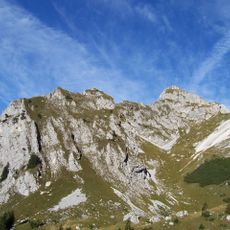
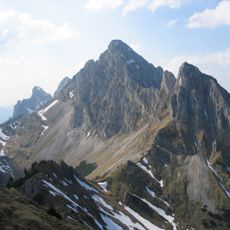
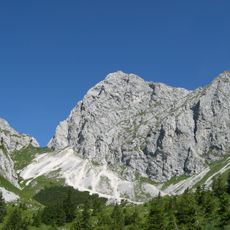
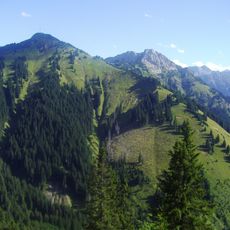
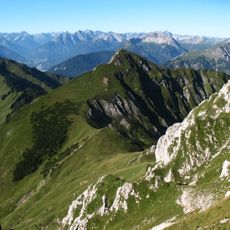
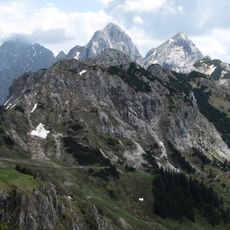
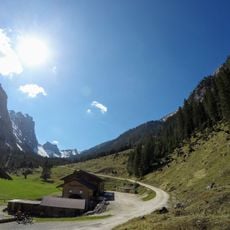
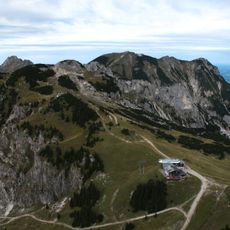
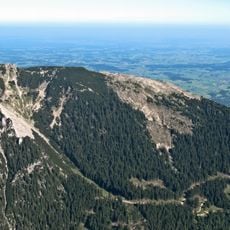
Babylonischer Turm, Mountain summit in Tyrol, Austria.
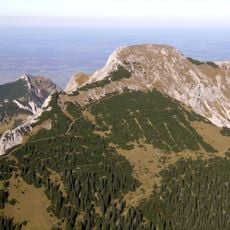
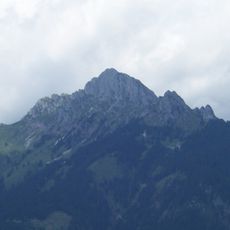
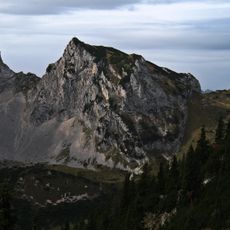
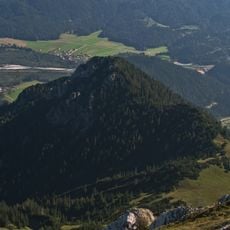
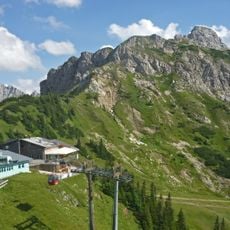
The Babylonischer Turm is a 2,060-metre rock needle on the eastern arête of the Kellenspitze (2,238 m), the highest summit of the Tannheim Mountains in Tyrol, Austria. From the south the pinnacle looks like an independent peak. Numerous climbing routes run up it, from the South Gully normal route (UIAA I–III) to the West Face (UIAA VI+ or A 3).
The South Gully normal route, graded UIAA I to III, was first climbed in 1904. The Southwest Arête followed in 1921 at grade IV+, and the West Face route was opened in 1959, requiring UIAA VI+ free or A 3 technical climbing. Short routes at V+ and IV+/A 0 were added on the Southeast Arête and Southeast Face in the mid-1980s.
The name Babylonischer Turm, "Babylonian Tower", is a climbers' nickname for the pinnacle, which from the south looks like a free-standing peak rather than a point on the Kellenspitze's east arête. The tower is known for its numbered routes, from the 1904 South Gully normal route to the 1959 West Face.
The tower stands on the eastern arête of the Kellenspitze (2,238 m) in the Tannheim Mountains of Tyrol. The normal route climbs the South Gully at UIAA grades I to III, so the approach is a roped alpine climb rather than a hike. The West Face route demands free climbing at VI+ or technical aid at A 3.
The Southwest Edge, developed in 1921, offers a direct but demanding path with steep rock sections. This route attracts experienced climbers looking for a different approach to the summit.
The community of curious travelers
AroundUs brings together thousands of curated places, local tips, and hidden gems, enriched daily by 93,925 contributors worldwide.