Rote Flüh, Mountain summit in Tyrol, Austria
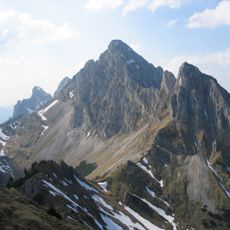
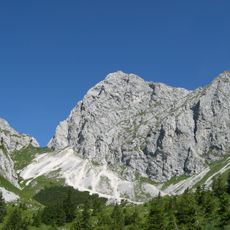
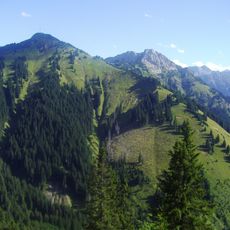
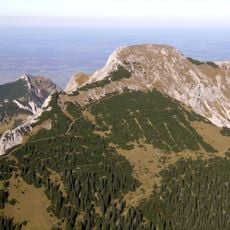
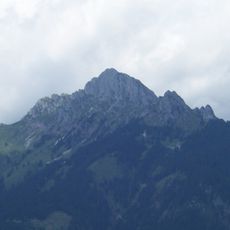
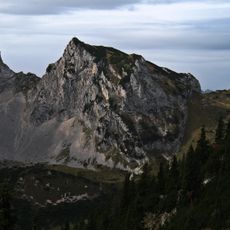
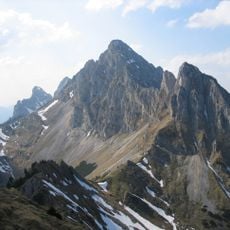
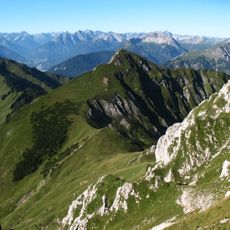
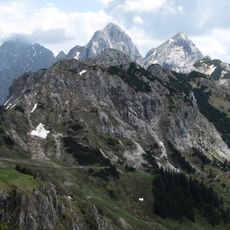
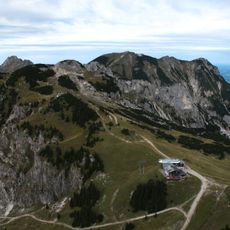
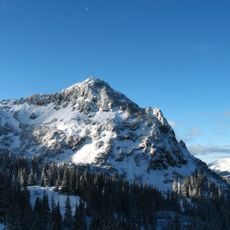
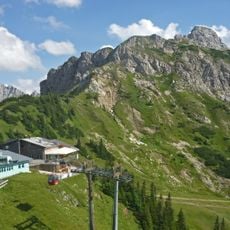
Rote Flüh is a 2,108-metre peak in the Tannheim Mountains of the Allgäu Alps, built of Wetterstein limestone. Its south and southwest faces form a broad wall above the cirque east of the summit, where the normal route climbs through a partly cable-secured gully. The Judenscharte links it to the Gimpel to the north, and the nearly two-kilometre west arête carries the Friedberger Klettersteig.
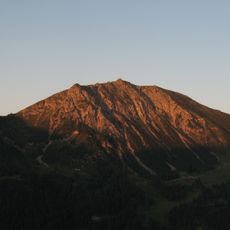
The name Rote Flüh refers to the layers of red limestone particles embedded in the mountain's Wetterstein limestone, which appear reddish at sunset. The peak is 2,108 metres high. After an anchor broke and a roped team fell, killing three people, almost all routes on the south face were re-equipped with bolts, though only old pitons were replaced and no extra protection was added.
The south face holds around 20 climbing routes, among them the Alte Südwand (UIAA 4, 260 m) and the Südverschneidung (UIAA 6+, 310 m); the Via Barbara reaches UIAA 8+ over 350 m. After a fall caused by a broken anchor killed three climbers, the belays were re-equipped with bolts while the old normal pitons were left in place, so the classic lines keep their traditional character.
You can reach the summit from several starting points including Musau, Nesselwängle, and the Haldensee area. Parking facilities and public transport connections are available at each of these trailhead locations.
The east ridge's visually minor rise carries its own name, Hochwiesler, because of the routes on its south face: 15 multi-pitch lines listed in Achim Pasold's guidebook, which dry quickly after rain and are popular in spring. From it a 30-metre abseil drops north and a 100-metre abseil south, the first half free-hanging for 45 metres.
The community of curious travelers
AroundUs brings together thousands of curated places, local tips, and hidden gems, enriched daily by 93,451 contributors worldwide.