Vagif Mausoleum, Constructivist mausoleum in Shusha, Azerbaijan
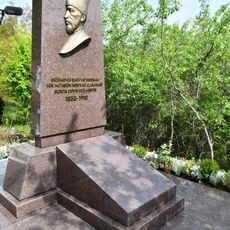
The Vagif Mausoleum is an 18-metre-high square tower on a slightly wider seat-like base, clad in reddish Karabakh marble, with anodised aluminium lattice covering the facades. The entrance portal bears the poet's name in large white marble letters, and inside a white marble hall a black marble chest stands over the grave. Sculptor A. Mustafayev's relief is set near the entrance.
Heydar Aliyev visited Shusha in 1967 and could not find Molla Panah Vagif's grave; on his instruction the grave was located, and a monument and mausoleum were built in 1980–1981. The mausoleum, designed by Abdulvahab Salamzadeh and Eldar Kanukov, opened on 14 January 1982 with Aliyev present. Armenian armed formations damaged it after taking Shusha on 8 May 1992, and it remained ruined until restoration by the Heydar Aliyev Foundation, reopened in August 2021.
The structure honors Molla Panah Vagif, a poet and diplomat whose works left a lasting mark on Azerbaijani literature and thought. His literary contributions remain central to how people in this region understand their cultural identity.
The mausoleum stands on the Jidir Duzu plain in the south-western part of Shusha, on the rocky hill where the poet was killed and buried. Restoration by the Heydar Aliyev Foundation began in March 2021, and the monument reopened in August 2021. The 18-metre-high structure has a flat concrete roof and facades covered with aluminium mesh; the poet's name is carved in white marble above the entrance.
The structure stands on the Jidir Duzu plain and was among the first modern memorial buildings in the region to be built using constructivist principles. This approach was unusual for its time and set it apart from traditional tombs in the area.
The community of curious travelers
AroundUs brings together thousands of curated places, local tips, and hidden gems, enriched daily by 93,820 contributors worldwide.