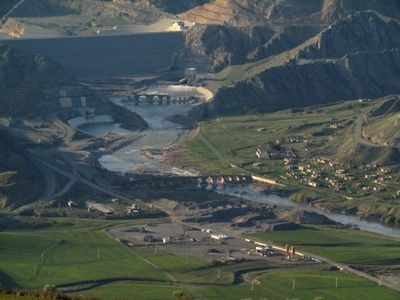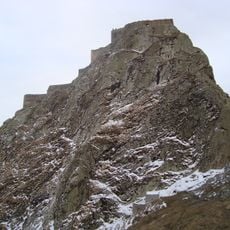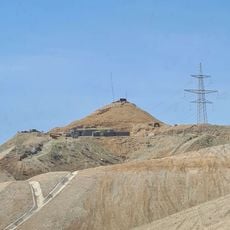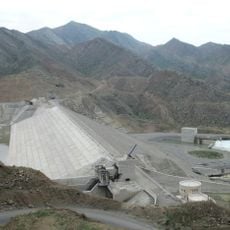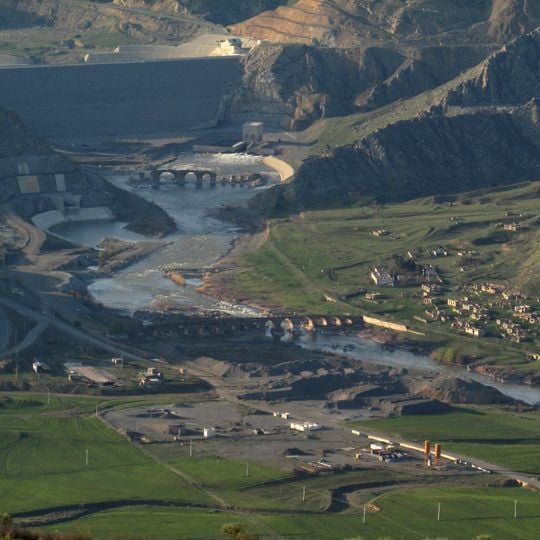
Khudafarin Bridges, Medieval stone arch bridges on Aras River between Azerbaijan and Iran.
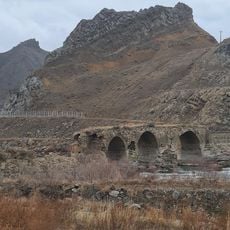
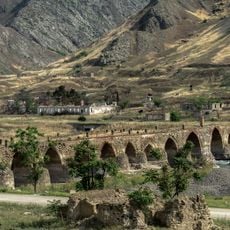
Khudafarin Bridges, also known as Khoda Afarin Bridges, are two medieval crossings over the Aras River near the border shared by Azerbaijan and Iran. One bridge stands on fifteen arches while the other rests on eleven, separated by a distance of roughly eight hundred meters.
The 14th-century geographer Hamdallah Qazvini recorded that the bridge was built in 636–637 by Bakr ibn Abdullah, though the surviving 15-arch structure is dated to the 12th century. The Shaddadid ruler Fazl ibn Muhammad ordered a bridge over the Aras in 1027, and the 11-arch bridge was rebuilt in the 13th century under the Ilkhanids. In 1795 Ibrahim Khalil Khan destroyed the bridge to block Agha Mohammad Khan Qajar's advance.
The name Khuda-Afarin means "created by God" in Persian, as recorded by the 14th-century historian Hamdallah Qazvini. The 15-arch bridge belongs to the Arran architectural school; its parapet is of square baked brick while the cutwaters and vaults use river cobblestone. The ruined 11-arch bridge is known locally as "sınıq körpü", the broken bridge.
Both structures lie within the border zone between Azerbaijan and Iran and remain inaccessible to ordinary visitors. Anyone wishing to visit requires official permission from authorities on both sides.
The 15-arch bridge is about 200 m long, 4.5 m wide and 10 m high, while the ruined 11-arch bridge, called "sınıq körpü" (broken bridge), is 130 m long, 6 m wide and 12 m high. The larger bridge's parapet is of square baked brick, and its mortar is said to have been made from clay mixed with milk.
The community of curious travelers
AroundUs brings together thousands of curated places, local tips, and hidden gems, enriched daily by 93,363 contributors worldwide.