Walled town of Počitelj, Ottoman fortified town in Čapljina, Bosnia and Herzegovina.
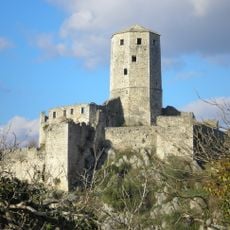
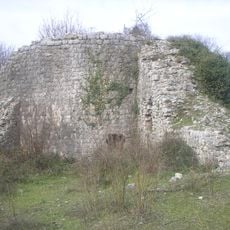
The Walled Town of Počitelj is a medieval fortified nucleus on the left bank of the Neretva, built in a natural karst amphitheatre about 30 km south of Mostar. Its stone walls enclose a citadel with the silo-shaped Kula on the northern corner, the Gavrankapetanović House, the Šišman Ibrahim Pasha Mosque and the Sahat Kula clock tower near the southern walls.
The earliest written records of Počitelj are charters from 1444 and 1448 issued by King Alfonso V and Emperor Friedrich III, though the fortified town was probably built around 1383 by Bosnian King Tvrtko I to control the Neretva trade route. Between 1464 and 1471 Vladislav Hercegović strengthened it with support from Dubrovnik, Hungary and the Pope. Ottoman rule from the 16th to 18th centuries added the mosque, bath and towers.
The mosque is also called Hajji Alija Mosque, after Hajji-Alija, son of Musa, who built it in 1563; locals renamed it for Šišman Ibrahim Pasha, who repaired it in the 17th century. Its dome gives the prayer hall notable acoustics. Badly damaged in 1993, it was restored in 2002.
The walled town sits on the left bank of the Neretva, about 30 km south of Mostar and 3 km northeast of Čapljina, on the Mostar–Metković road. Entry is through the historic gate; inside, the lanes are stone-paved and climb steeply past the citadel, so allow time for stairs and wear shoes with grip.
The Gavrankapetanović House, built at the end of the 16th century, was the only house in town with separate rooms for men and women. Between 1961 and 1975 it housed an artists' colony, the longest operating in Southeast Europe, where the Italian painter Vittorio Miele worked. Burned during the Bosnian war, it was restored to its original state in 2003.
The community of curious travelers
AroundUs brings together thousands of curated places, local tips, and hidden gems, enriched daily by 93,831 contributors worldwide.