Peperbus, Watchtower on the Isabellakaai in Ghent, Belgium
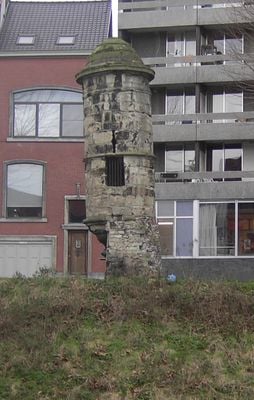
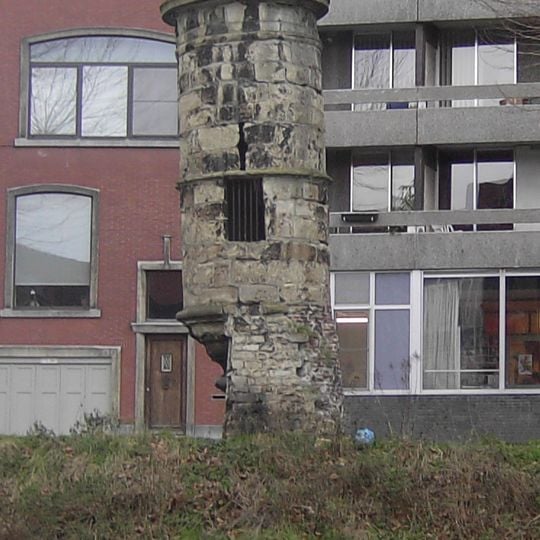
The Peperbus is a small watchtower of the erkertoren type, a projecting turret on the former city wall along the Isabellakaai on the Muinkschelde. It is built of rough grey and brown stone blocks in a tapering cylinder that ends in a broken rim without a roof. A narrow vertical opening with dark metal bars sits halfway up, above a rounded corbel.
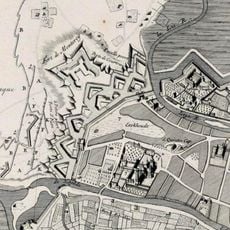
Construction of the defensive works that included the tower began on 27 May 1658 and was finished two years later. A matching tower on the opposite bank of the Scheldt was demolished in 1860. After Ghent's walls were torn down in the 19th century, the Peperbus remained almost the only visible fragment of the old fortifications. It was listed as a monument in 1987.
Locals call the tower Peperbus, "pepper mill", after its shape, and the nickname has stuck for centuries. It is the last survivor of two small watchtowers that stood at the ends of a wall between the Scheldt and the Leie, and since the walls came down it has served as a boundary marker of the old urban toll area.
The tower stands on the Isabellakaai on the bank of the Muinkschelde, where the river once crossed the city walls. It has no interior to visit; the structure is seen from the quay and the opposite bank. The surrounding area is built up with modern blocks, so the tower is best picked out from the waterfront.
The name Peperbus refers to the shape of the tower resembling a pepper mill, with this word used in local speech for cylindrical or tube-like objects. This designation has persisted for centuries and remains in use today.
The community of curious travelers
AroundUs brings together thousands of curated places, local tips, and hidden gems, enriched daily by 94,036 contributors worldwide.