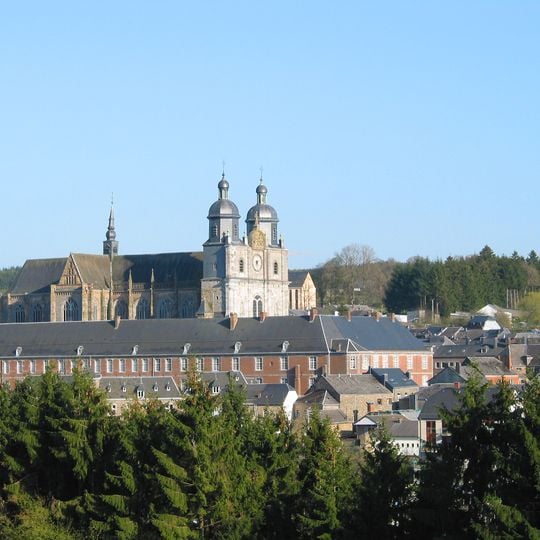
Saint-Hubert abbey, Benedictine abbey in Saint-Hubert, Belgium
Saint-Hubert abbey is a Benedictine monastery in the town of Saint-Hubert featuring an 18th-century baroque facade that frames gothic interior spaces. The complex has a distinctive roof structure and includes multiple buildings arranged around courtyards.
The monastery was founded in 687 and developed initially as a Benedictine settlement under the protection of Pepin II. After the transfer of Saint Hubert's remains in 825, it became an important spiritual center and pilgrimage destination.
The town and abbey took their name from Saint Hubert, whose remains were brought here on 30 September 825. From the 10th century the monks bred strong hounds with a keen nose, used to track lost travellers in the forest; three pairs were sent yearly to the king of France. The 15th-century legend of the stag bearing a cross between its antlers made Hubert patron of hunters, foresters, tanners and butchers.
The former abbey church, now a minor basilica of the diocese of Namur, stands in the centre of Saint-Hubert, in the province of Luxembourg. The complex was listed as built heritage in 1938 and as an exceptional monument in 2016. Approach on foot from the town centre; the church is the tall building with two domed towers and a spire.
The Cantatorium of Saint-Hubert, a chronicle written around 1100 and named after the music book in which it was first recorded, is a major source for the Investiture Controversy in the diocese of Liège. Karl Hanquet published an edition in 1906.
The community of curious travelers
AroundUs brings together thousands of curated places, local tips, and hidden gems, enriched daily by 93,532 contributors worldwide.