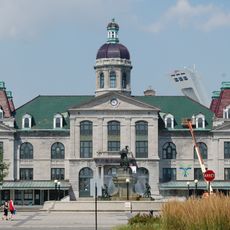
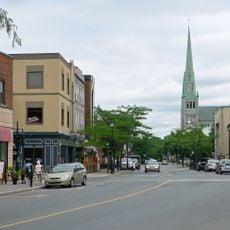
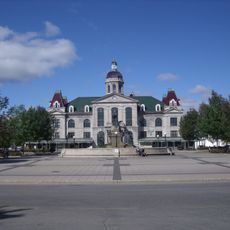
Co-Cathedral of Saint-Antoine-de-Padoue, Gothic Revival cathedral in Le Vieux-Longueuil, Canada.
The Co-Cathedral of Saint-Antoine-de-Padoue is a house of worship featuring eclectic architectural elements in Le Vieux-Longueuil. Its most striking feature is a Byzantine Revival dome that rises prominently above the building's main structure.
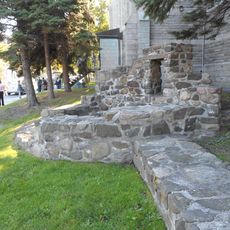
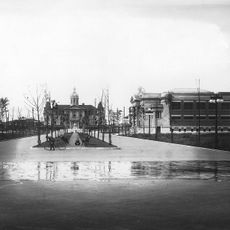
The parish of Saint-Antoine-de-Padoue was founded in 1698, one of the oldest in Canada. The present church, the third on the site, was built from 1884 to 1887 to plans by Henri-Maurice Perrault and Albert Mesnard and completed in 1911. It became a co-cathedral in 1982 when the Diocese of Saint-Jean-de-Québec was renamed Saint-Jean-Longueuil. The site holds remains of Fort Longueuil, built 1685–1690 for Charles le Moyne and demolished in 1810.
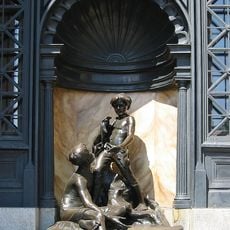
The interior holds a set of religious sculptures: the apostles, the Magi, Saint Charles Borromeo, Saint Joseph, Saint Marguerite Bourgeoys and the Canadian martyrs, among others. The stained-glass windows recount the life of Saint Anthony of Padua. André Achim carved the polychrome wooden baptismal font, the organ case and the screen behind the main altar; Louis-Amable Quévillon made the paschal candlestick.
The location is easily accessible on foot given its central position in Le Vieux-Longueuil. Visitors should check opening times beforehand, as access may vary depending on services and events taking place inside.
Archaeological remnants of Fort Longueuil lie beneath the site, a fortified residence built between 1685 and 1690. These buried layers tell the story of an earlier settlement that occupied the location long before the cathedral was constructed.
The community of curious travelers
AroundUs brings together thousands of curated places, local tips, and hidden gems, enriched daily by 93,799 contributors worldwide.