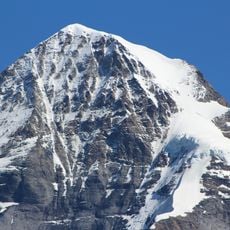
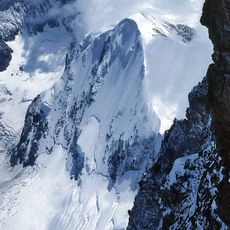
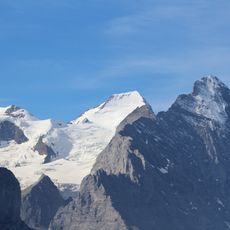
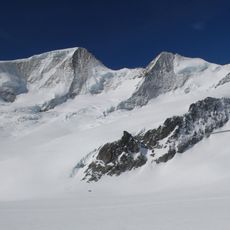
Gross Fiescherhorn, Mountain summit in the Bernese Alps, Switzerland
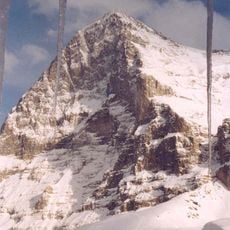
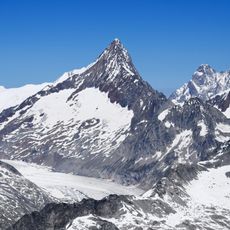
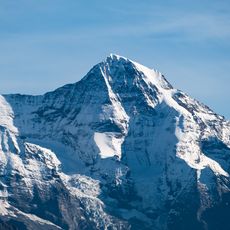
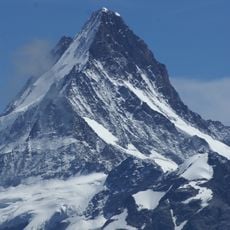
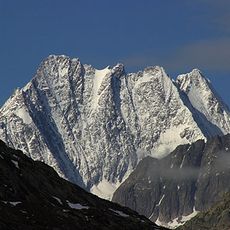
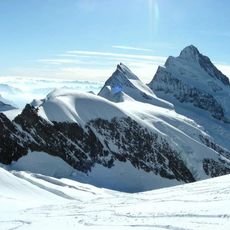
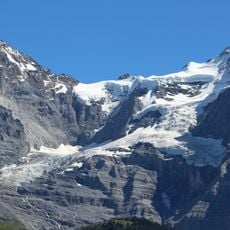
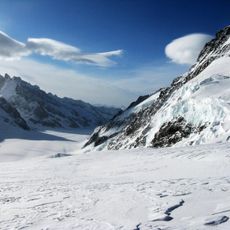
Grosses Fiescherhorn is a 4,049 m summit of the Bernese Alps on the Bern–Valais border, the highest of the Fiescherhörner above Hinteres Fiescherhorn (4,025 m) and Kleines Fiescherhorn (3,895 m). Three ridges run northwest, east and southeast; the north side drops as the roughly 1,250 m high, 4 km wide Fiescherwand, while the south side is almost entirely glacier-covered.
The summit was first reached on 23 July 1862 by H. B. George and Adolphus Warburton Moore with guides Christian Almer and Ulrich Kaufmann, via the south-west ridge, now the normal route. On 13 August 1926 W. Amstutz and P. von Schumacher climbed the north ridge in 15 hours. In 1930 Willo Welzenbach and Heinz Tillmann made the first direct ascent of the Fiescherwand in 12 hours.
The summit marks the cantonal border between Bern and Valais, which follows the Aare-Rhone watershed along the main Bernese Alps ridge. The mountain belongs to the municipalities of Grindelwald, about eight kilometres away, and Fieschertal. The name Fiescherhorn refers to the Fieschertal valley; the massif also includes the Hinteres Fiescherhorn and the Kleines Fiescherhorn, called Ochs (ox).
Climbing requires experience and specialized equipment because steep rock and glaciers are part of the standard route. Several mountain huts in the region provide lodging and starting points for the different approaches to the summit.
The north face is known for its technical difficulty and ranks among the most demanding climbing routes in the Bernese Alps. The route typically takes longer than 15 hours and attracts climbers seeking a serious alpine challenge.
The community of curious travelers
AroundUs brings together thousands of curated places, local tips, and hidden gems, enriched daily by 94,042 contributors worldwide.