Mondmilchloch, Solutional cave in Pilatus massif, Switzerland
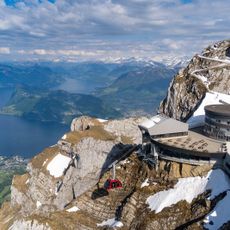
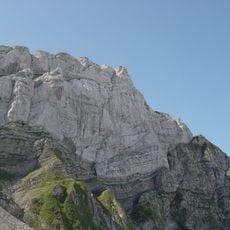
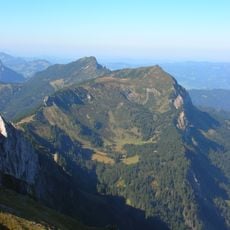
Mondmilchloch is a solutional cave on the south side of the Widderfeld in the Pilatus massif, at 1710 m above sea level. It runs 170 m with a vertical extent of 22 m. After a hall-like antechamber and a transition zone, a fissure-shaped section leads to a 3.3 m waterfall; at 57–62 m the passage is so low that one must crawl. A 20 cm squeeze called the Mousetrap precedes the second waterfall, 2.2 m high, at 100 m.
The cave was first mentioned in 1555, when Conrad Gesner introduced its white calcite deposit into the official pharmacopoeia as Lac Lunae (moon milk). The remedy gained wide renown and was still medically recommended in the 19th century.
The name Mondmilchloch means a cave holding moon milk (Latin lac lunae) in large quantities. Conrad Gesner introduced the substance into the official pharmacopoeia in 1555 as Lac Lunae, and the calcite precipitate was still being recommended by physicians in the 19th century.
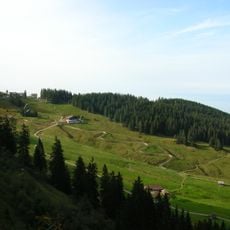
From the Alp Birchboden buildings (1610 m) an orange-dotted path leads to the cave entrance at 1710 m, first level then slightly uphill over pasture, scree and strips of forest. The entrance is only seen when standing directly in front of it; the stream flowing out of the cave can serve as a guide. The cave is 170 m long with 22 m of vertical extent, and from 57 to 62 m the passage is so low that you can only advance on all fours.
The cave is the type locality of moon milk, a white porous calcite precipitate. It forms when water runs down or drips from the cave walls and chemically pure calcium carbonate settles out. The cave lies along a tectonic fault in the lower Schrattenkalk limestone, dissolved by carbonic acid water.
The community of curious travelers
AroundUs brings together thousands of curated places, local tips, and hidden gems, enriched daily by 93,674 contributors worldwide.