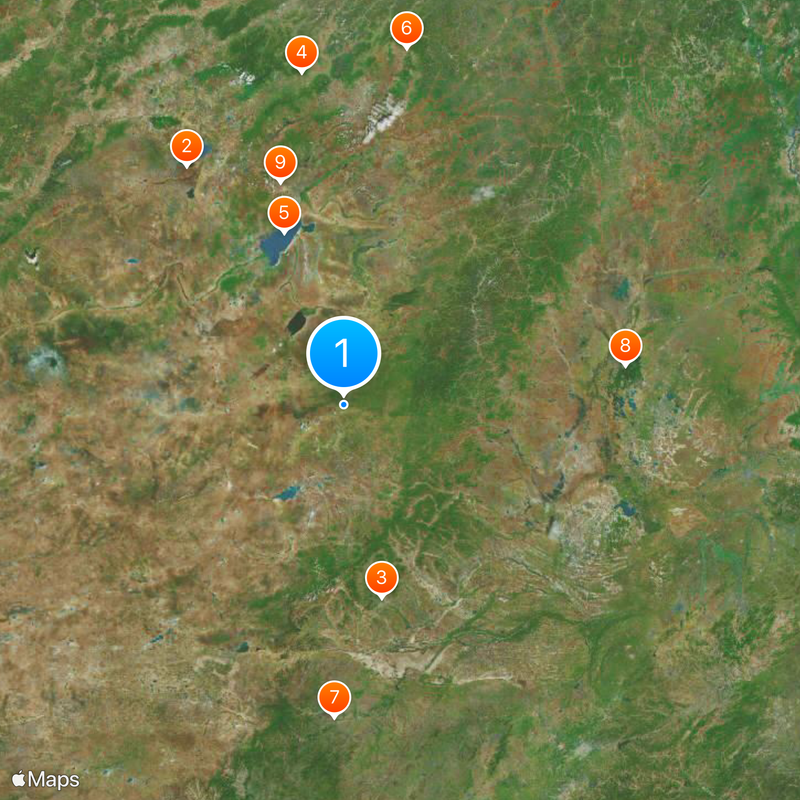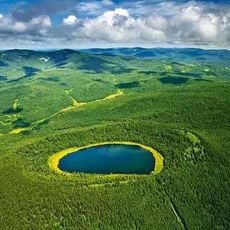
Mongolian-Manchurian grassland, Temperate grassland ecoregion in eastern Mongolia, Inner Mongolia, and Northeast China.
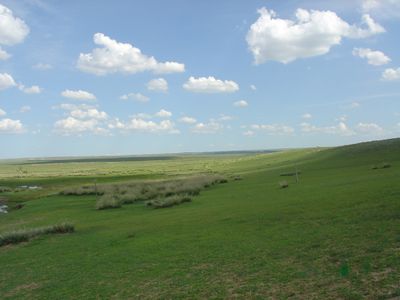
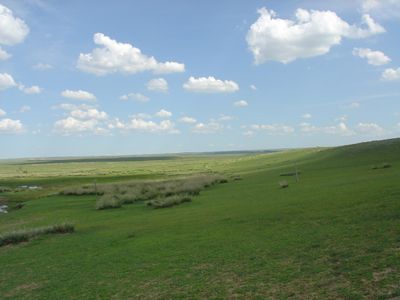
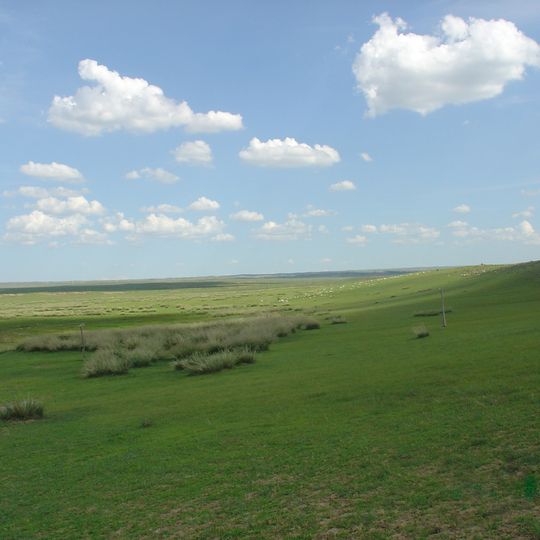
The Mongolian-Manchurian grassland is an 887,300-square-kilometre ecoregion (PA0813) forming a crescent around the Gobi Desert, from the Altai Mountains to the Greater Khingan. Most of it is flat or gently rolling plain at 1,000–1,300 m, dominated by feather grass, sheep's fescue and Aneurolepidium chinense. The photograph shows green grass, a rounded hill on the right, greyish-green shrub clusters and grazing animals as white specks.
Under the Mongol Empire the grassland became part of the Northern Silk Road, an addition to the original route once the Mongols controlled China. Travellers crossed it east–west to bypass mountains, and the open terrain helped the Mongols expand into parts of China and Korea. Marco Polo, the sources note, did not travel this way.
Most people in the steppe are Mongolian nomads who live in gers, large portable tents, and families own many horses that roam the grassland. They use the animals for food and drink, and traditional Mongolian songs form a prominent part of their culture.
January means average temperatures of minus 9 °C or lower, dropping below minus 20 °C on the transmontane grasslands northwest of the Da Hinggan range, where no mountain barrier blocks northwest winds. Annual precipitation falls from 400–450 mm in the east to 150–200 mm in the west, concentrated in a weak summer monsoon. The terrain is flat or gently rolling at 1,000–1,300 m, so a local guide helps with orientation.
Mongolian gazelle herds gather in remarkable numbers during late summer as the grasslands shift in color before the cold season arrives. These seasonal migrations rank among the largest terrestrial animal movements on Earth.
The community of curious travelers
AroundUs brings together thousands of curated places, local tips, and hidden gems, enriched daily by 93,401 contributors worldwide.