Bingling Temple, Buddhist complex in Gansu, China
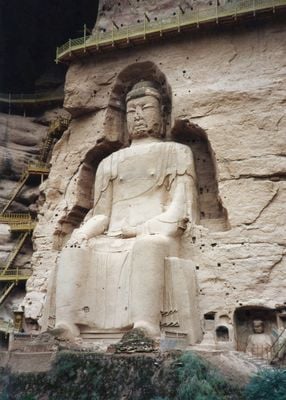
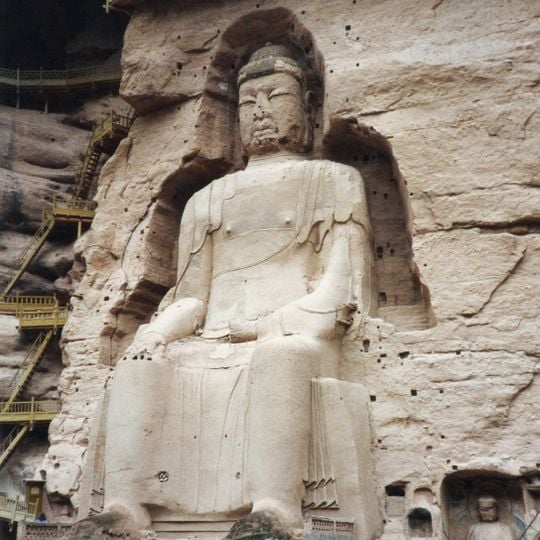
Bingling Temple is a group of grottoes carved into the cliff on the west side of Dasi Gully, on Jishi Mountain in Yongjing County, Gansu. The site holds 183 caves, 694 stone statues and 82 clay sculptures, including a seated Maitreya Buddha over 27 metres tall in a natural cavern. The caves line the north side of the canyon for about 200 metres.
The first grotto was begun around 420 CE under the Western Qin, and the site is first recorded as Tangshu Cave, a Qiang name meaning "ghost cave". Carving continued through the Wei, Sui, Tang, Song, Yuan, Ming and Qing dynasties. Cave 169 holds an ink inscription dated to the first year of Jianhong (420), the earliest dated record here. The name changed over time: Longxing Temple in the Tang, Lingyan Temple in the Song, Bingling from the Ming Yongle era.
The name Bingling derives from Tibetan 'Bum gling', meaning 'hundred thousand ling' or 'ten thousand Buddhas', though scholar Cairang links it to the Chinese 'Fenglin' recorded in the Old Book of Tang. Cave 169 holds a black-ink inscription dated to the first year of Jianhong (420 CE), the site's earliest dated record.
Boats leave from near the Liujiaxia Dam in Liujiaxia City, the seat of Yongjing County, and sometimes from other docks on the reservoir. The site can only be reached in summer and fall; the rest of the year it is inaccessible because there are few roads. From central Lanzhou the drive takes 2.5 hours over very winding roads.
The giant seated Maitreya Buddha, over 27 metres tall, closes the line of grottoes at a natural cavern reached by wooden walkways winding up the rock face. Small drilled holes dot the cliff around it, left by the timber scaffolding used to carve and shelter the figure.
The community of curious travelers
AroundUs brings together thousands of curated places, local tips, and hidden gems, enriched daily by 92,802 contributors worldwide.