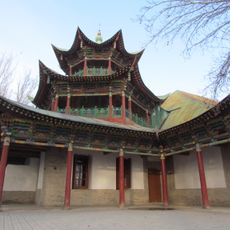
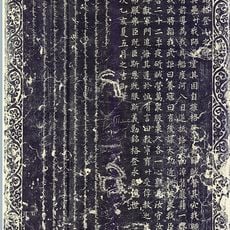
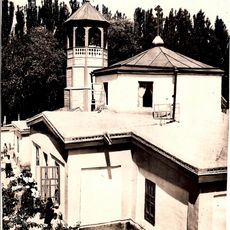
Tughluq Timur Mausoleum, Mongol dynasty mausoleum in Huocheng County, China.
Tughluq Timur Mausoleum is a rectangular brick tomb about 11 m wide and 14 m high, crowned by a large brick dome. Its near-square facade has a recessed pointed arch whose tympanum carries the word Allah in Kufic script in white and blue tile, while white, blue and purple glazed tiles cover the walls. Inside are two sarcophagus-shaped graves, of Tughluq Timur and his son.
Tughluq Timur, the first khan of Moghulistan and a descendant of Chagatai, died around 1362–1363; the tomb was raised years later at the expense of his widow Tini Khatun. Chinese sources date the burial chapel to 1363–1369. It stands near Almalik, his vanished capital, and in 1871–1881 the area belonged to the Russian-occupied Ili region.
Local tradition holds that a smaller neighbouring building of similar design holds Tughluq Timur's daughter or sister. The main tomb's facade carries the word Allah in Kufic script on white and blue tiles, and its decoration uses over twenty patterns in blue, green, red, yellow and white glazed brick.
The site is located in Ili Kazakh Autonomous Prefecture and can be reached via local transportation routes from major Xinjiang cities. Visitors should expect variable ground conditions and bring appropriate clothing, as the region experiences a continental climate.
The glazed tiles on the facade were made locally, and archaeological analysis shows they were already being produced in Xinjiang in the early 14th century. More than 20 patterns of blue, green, red, yellow and white tiles and mosaics cover the building.
The community of curious travelers
AroundUs brings together thousands of curated places, local tips, and hidden gems, enriched daily by 94,276 contributors worldwide.