Dzungarian Gate, Rail mountain pass in Bole, China
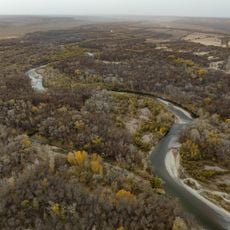
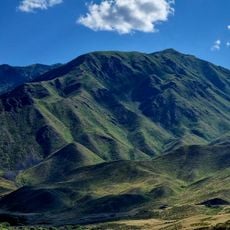
The Dzungarian Gate is a straight, flat valley about 50 km long and over 10 km wide at its narrowest, cutting between the Dzungarian Alatau and the Barlyk range on the Kazakhstan-China border. Its floor lies at roughly 340 m, with peaks rising to 3,000 m and 4,600 m on either side. A road with a yellow center line and a broad crosswalk runs through it, and a lattice communications tower stands near the roadside buildings. The railway linking Dostyk and Alashankou passes through the same corridor.
The pass was used by nomadic peoples of Central Asia as a transport route, and the northern Silk Road ran through it. In the early 13th century Genghis Khan used it to conquer Central Asia. The name entered Russian literature after I. V. Mushketov gave it in 1875. A railway was built through the corridor between 1954 and 1990, linking Aktogay, Dostyk, Alashankou and Urumqi.
The name Dzungaria comes from the Dzungars, the left wing (züün, left; gar, hand) of the Oirat Mongolian army, a kingdom raised to prominence by Galdan in the later 17th century until the Qing defeated it around 1757–1759. Russian literature adopted the name "Dzungarian Gate" after I. V. Mushketov first used it in 1875. Herodotus' account of griffins guarding gold and the North Wind issuing from a cave led scholars such as Carl Ruck and Ildikó Lehtinen to link the pass with Boreas and Hyperborea.
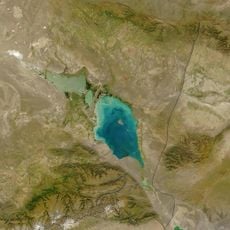
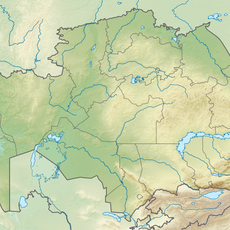
The corridor is a flat, wide valley about 50 km long, with Lake Alakol at its northern entrance and Ebinur Lake at its southern end; the Kazakh station of Dostyk and the Chinese station of Alashankou lie inside it. Winds can reach 70 m/s, and the dry southeastern "ibe" wind blows in cold weather. Check the forecast and carry windproof clothing.
The Dzungarian Gate lies at the continental pole of inaccessibility, the point on land farthest from any ocean. The valley funnels air so that winds can reach 70 m/s; the dry south-easterly winter wind from China is called ibe, while the north-westerly wind from the Kazakh steppes is the saikan. Kazakhstan plans a wind farm near Lake Alakol, and China has run a similar project since 2009.
The community of curious travelers
AroundUs brings together thousands of curated places, local tips, and hidden gems, enriched daily by 92,781 contributors worldwide.