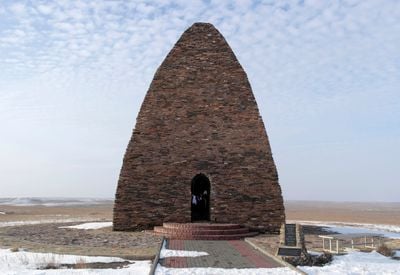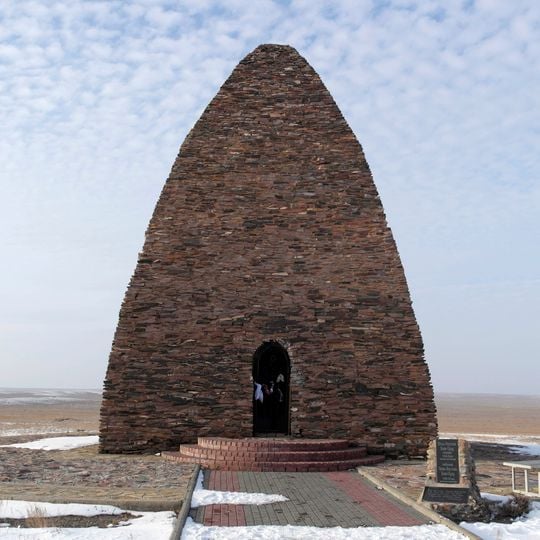
Kozy-Korpesh and Bayan-Sulu mausoleum, Mausoleum near Tansyk railway station, Kazakhstan.
The Kozy-Korpesh and Bayan-Sulu mausoleum is a conical structure of stacked rough flat stones in reddish brown, gray and tan, rising from a square base of 7.1 by 7.1 m to a rounded pointed top at 11.65 m. Its walls, 1.86 m thick, are granite slab set in clay with straw, and a dark arched doorway faces east. A low three-tiered semicircular brick platform stands before the entrance.
The mausoleum was built in the 10th–11th centuries, making it one of Kazakhstan's oldest surviving monuments, though its appearance has changed over time. In 1856 Shokan Ualikhanov sketched the mausoleum and the stone sculptures beside it; Nikolai Abramov examined the site in 1858 and Nikolai Pantusov in 1898. Alkey Margulan led an Academy of Sciences of the Kazakh SSR expedition there in 1952, and in 1982 the mausoleum was listed as a monument of republican significance.
The site preserves a story central to Kazakh oral tradition: a tale of two lovers whose sacrifice shaped how the people remember love and devotion. Walking through the grounds, you feel the weight of this legend that has been passed down for centuries.
The mausoleum stands on the right bank of the Ayagoz River, 7 km southwest of Tarlauly village and 11 km west of Tansyk station in Ayagoz District. There is no developed infrastructure at the site, so bring sturdy shoes for the open ground. Snow patches remain around the structure in cold months.
The four stone figures once standing by the mausoleum are gone. The first drawing of them was made in 1771 by G. Voloshin, and Shokan Ualikhanov sketched them in 1856. In 1915 the local historian A. N. Beloslyudov reported that the figures had disappeared and that, according to his brother Viktor, they had been taken to Germany.
The community of curious travelers
AroundUs brings together thousands of curated places, local tips, and hidden gems, enriched daily by 93,477 contributors worldwide.