Mausoleum of Abai Qunanbaiuly, Cultural monument in Abay District, Kazakhstan
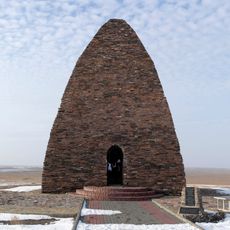
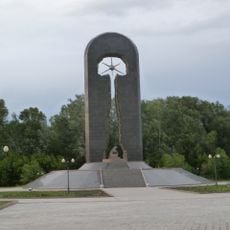
The Mausoleum of Abai Qunanbaiuly is a tower-like structure on a hill in Zhidebay, Abay District, built in 1996. A 200-metre platform, 65 metres wide and 5 metres high, links the graves of Abai and Shakarim, 140 metres apart, and is divided into three tiers: black for the underworld, red for the living, white for the heavenly world. The Abai tower rises 32.5 metres, the Shakarim tower 31.5 metres, and four corner towers stand at the edges. Mangystau shell limestone was used in the construction.
The mausoleum was built to honor a literary figure who lived from 1845 to 1904 and founded written Kazakh literature through translations and original compositions. This person remains central to Kazakh cultural history and is remembered as the creator of modern Kazakh literary tradition.
The platform's three tiers correspond to the Kazakh cosmos: black for the underworld of the dead, red for the world of the living, white for the heavenly world of spirits and Allah. Four corner towers let pilgrims spend the night, read prayers and perform the rite of health and luck at the aruakh spirits. Abai's brother Ospan lies buried with him, and nearby are the graves of his mother Ulzhan (1810–1887) and grandmother Zere (1785–1873).
The site is best visited during daylight hours to fully appreciate the architecture and decorations and explore the different areas of the complex. Access to the various sections is straightforward, and visitors should wear comfortable shoes to walk through the entire grounds.
The platform's three tiers are coloured black, red and white, matching the Kazakh cosmological levels of the underworld, the world of the living and the heavenly world of spirits. Four corner towers let pilgrims spend the night and pray at the aruakh spirits for health and good fortune.
The community of curious travelers
AroundUs brings together thousands of curated places, local tips, and hidden gems, enriched daily by 93,463 contributors worldwide.