Natural Monument "Charyn ash forest", Relict ash grove natural monument in Uygur District, Kazakhstan
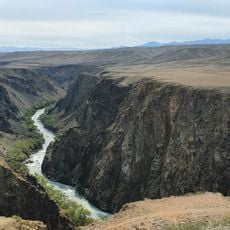
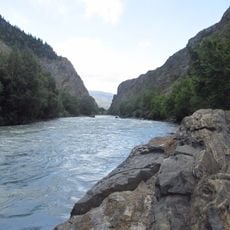
Natural Monument 'Charyn ash forest' covers thousands of hectares of dense Sogdian ash trees that grow in groves along the banks of the Charyn River. The woodland features multiple layers of trees and vegetation that follow the river's course through the landscape.
The forest received legal protection in 1964 when authorities recognized the ecological importance of preserving this rare ash woodland. The forest has remained largely unchanged since then, maintaining its value as a key natural site in the region.
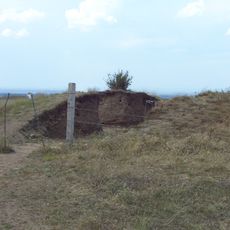
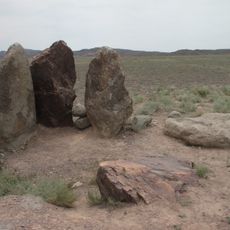
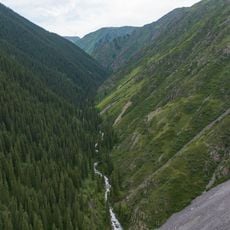
The Sogdian ash is called "recolubivy" by botanists because it grows only beside rivers; here it survives only along the lower Charyn and in the canyon of its tributary Temirlik. Nearby, hundreds of small ancient burial mounds built of large stones stretch in a narrow chain for many kilometres. The large Sartogay mounds, framed by a wide stone ring or a square raised like a rampart, differ clearly from other mounds of Semirechye, probably marking a particular clan or tribe.
The grove lies in the Sartogay tract on the middle course of the Charyn River, in Uygur District of Almaty Region, within Charyn National Park. Felling is banned and rangers' cordons guard the site, so access follows the park's rules. The ash itself covers only 800 of the 4,855 hectares, so expect open ground between the groves.
The grove protects Sogdian ash, a species that survives in Kazakhstan only in the lower Charyn and in the canyon of its tributary Temirlik. Nearby, hundreds of small burial mounds built of large stones run in a narrow chain for kilometres; the large Sartogay kurgans are framed by a wide stone ring or a square raised like a rampart.
The community of curious travelers
AroundUs brings together thousands of curated places, local tips, and hidden gems, enriched daily by 93,474 contributors worldwide.