Assy-Turgen Observatory, Astronomical observatory in Almaty Region, Kazakhstan.
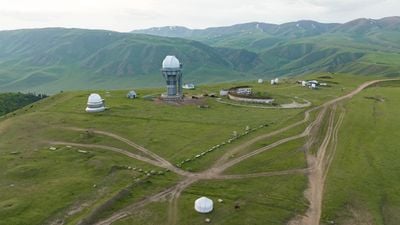
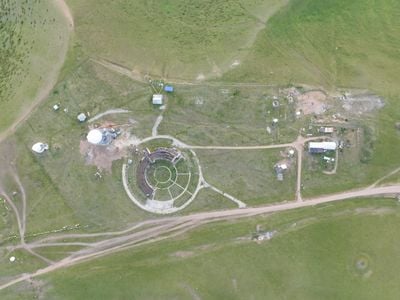
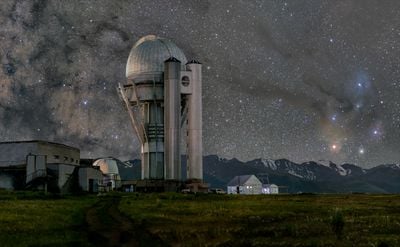
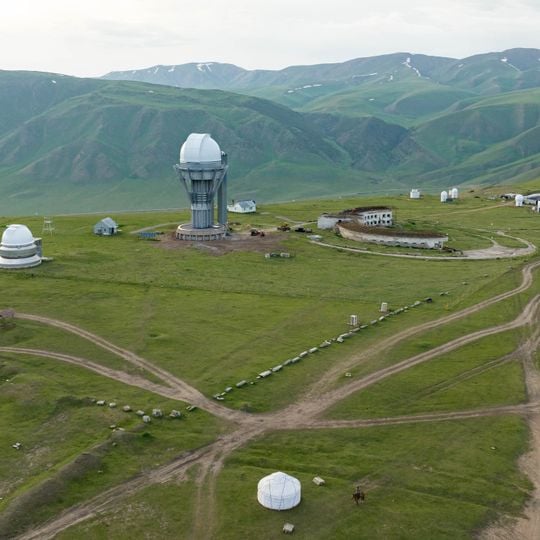
Assy-Turgen Observatory, named after academician T. B. Omarov, stands on the Assy plateau of the Trans-Ili Alatau at 2,750 m, 75 km east of Almaty. Its white dome and cylindrical upper section rest on a grey open lattice tower; a smaller white-domed building stands to the left. Nearby, a flat circular formation is divided into segmented rings around a central hub.
Construction began in 1975 on a site chosen by Konstantin Salamakhin after astroclimate surveys. The Zeiss-1000 telescope entered service in 1981. Work on the 45-meter dome for the AZT-20 was frozen in 1992, resumed in 2014, and the telescope saw first light in October 2016, entering regular operation in 2017.
The observatory is named after Academician T. B. Omarov, and its work is tied to the Fesenkov Astrophysical Institute. The 45-metre dome of the AZT-20 was built to resemble an edelweiss, a mountain flower. Astronomers here study variable stars, planetary nebulae and the optical afterglow of gamma-ray bursts.
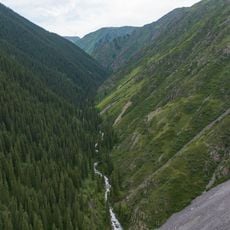
The observatory sits on the Assy plateau at 2,750 m, 75–85 km east of Almaty; the nearest city is Esik. The final stretch is a mountain track, so access is by off-road vehicle. The air is thin and the weather cold even in summer; the site lies within a national park.
The site was proposed by Konstantin Matveyevich Salamakhin, based on the work of an astroclimatic expedition. The observatory's average FWHM is under 2 arcseconds, which the Fesenkov Astrophysical Institute calls the best astroclimatic conditions in Kazakhstan. The 45-metre dome built for the AZT-20 was designed to resemble an edelweiss, a mountain flower.
The community of curious travelers
AroundUs brings together thousands of curated places, local tips, and hidden gems, enriched daily by 94,109 contributors worldwide.