Hong Kong Kun Chung Temple, Buddhist temple in Hong Kong, China.
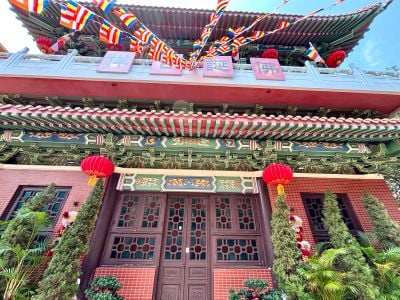
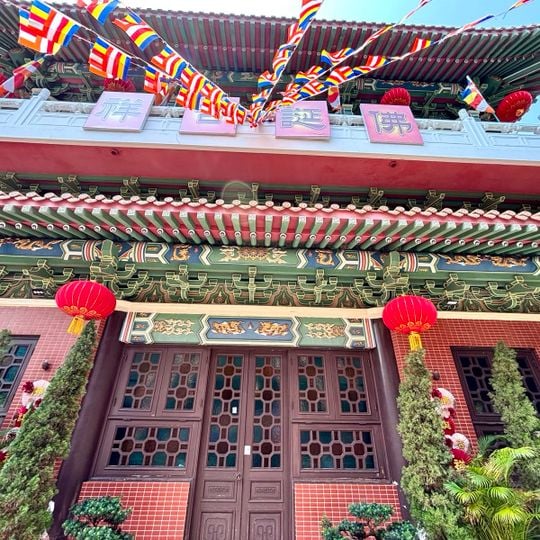
Hong Kong Kun Chung Temple is a Buddhist temple featuring traditional Chinese architectural elements including a central prayer hall, multiple shrines, and detailed stone carvings throughout. The structure displays classic features of East Asian religious buildings.
The temple traces back to 1935, when Master Baojing founded the Jing Lu retreat on this site. It lay abandoned during the Japanese occupation and was revived in 1945 by the Venerable Jueguang, who had come south. The present main hall was rebuilt in 1978 from the former Bao Gong Sheng Xi Memorial Hall.
The temple belongs to the Tiantai school, a lineage traced to the monk Zhiyi, and is one of the few remaining Tiantai temples in Chinese Buddhism. It is a branch of the Heung Hoi Ching Kok Association, and its abbot is Venerable Hong Ming. On 20 March 2004 it hosted Hong Kong's first legally recognised Buddhist wedding, witnessed by Venerable Jue Guang, founder of the association.
The temple stands at 12 Chi Fook Wui, Fan Ling, in the New Territories. The entrance is on the right side of the gate, where the memorial stupa for Master Bao Jing stands with its inscription on his life and the temple's founding. The lower hall doubles as a recreation centre for two affiliated old-age homes, so it is busiest when residents gather.
The temple keeps a Sanskrit palm-leaf manuscript of the Buddhist canon in the Guanyin hall on the upper floor, behind the Hall of the Three Buddhas. The lower hall doubles as a recreation centre for two affiliated old people's homes. Beside the main entrance stands a stupa with an inscription on the life of Master Baojing and the building of the temple.
The community of curious travelers
AroundUs brings together thousands of curated places, local tips, and hidden gems, enriched daily by 92,788 contributors worldwide.