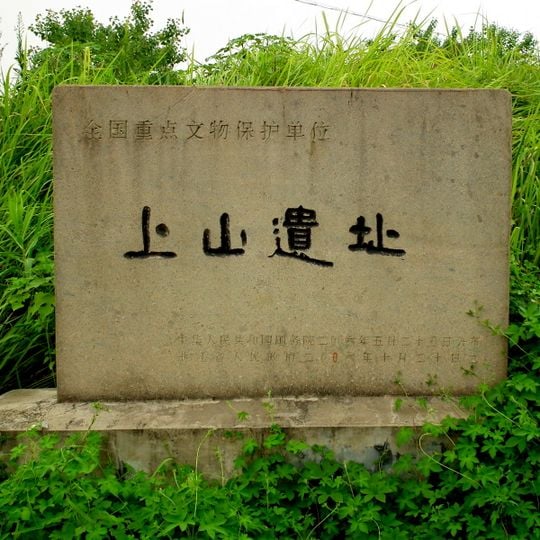
Shangshan, Archaeological site in Pujiang County, China.
Shangshan is an early Neolithic site in Qubei Village, Huangzhai Town, Pujiang County, Zhejiang, on a low hill about 3–5 m high beside the upper Puyang River. Excavations in 2001, 2004 and 2005 covered some 1,800 m² and yielded stone tools, red-coated pottery, house and ash-pit remains, and early cultivated rice.
Systematic investigation since 2000 has revealed settlement and agricultural practices spanning roughly 11,000 years of human history. The evidence suggests this location emerged as a major center for early farming development.
The site gave its name to the Shangshan culture, defined at a 2006 conference in Pujiang County. Its pottery is red-coated, low-fired and thick-walled, with rice husk grains visible in the clay; the grains are shorter and wider than wild rice, indicating cultivated rice. A find of about 10,000-year-old rice wine is also reported from the site.
The site lies on a low hill about 3–5 m high on flat ground at roughly 50 m elevation, near the upper Puyang River in Qubei village, Huangzhai town. Excavated areas cover about 1,800 m². The remains span the early Neolithic through the Tang and Song periods and later.
Rice husks embedded in the fabric of red-coated pottery from the site were identified as domesticated rice, with grains shorter and wider than wild rice. The pottery was fired at low temperatures, and the husks remain visible on the vessel surfaces.
The community of curious travelers
AroundUs brings together thousands of curated places, local tips, and hidden gems, enriched daily by 94,269 contributors worldwide.