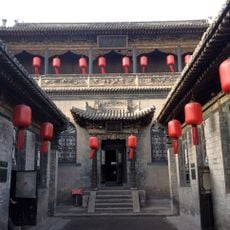
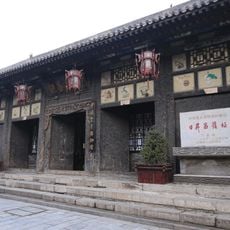
Qingxu Guan, Taoist temple in Pingyao, China.
Qingxu Guan is a Taoist temple complex at 109 East Street in Pingyao, 100 metres inside the Xiagong gate of the city wall. It faces north, covers 5,890.9 square metres and has three courtyards. On the axis stand a wooden paifang, the mountain gate, the Yuan-dynasty Longhu Hall, Chunyang Palace, the Sanqing Hall of 1600 and the Yuhuang Pavilion; the Pingyao County Museum is housed here.
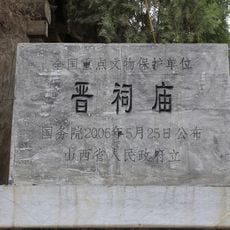
Founded in 657 under the Tang emperor Xianqing as Taiping Guan, the temple was renamed Qingxu Guan by Emperor Yingzong of the Northern Song in 1064. Under the early Yuan it became Taiping Xingguo Guan, home to the Quanzhen patriarchs Yin Zhiping and Li Zhichang, and in 1252 Möngke Khan ordered it renamed Taiping Chongsheng Gong. It took its present name again in the Qing dynasty and was listed as a national heritage site on 25 May 2006.
The temple now houses the Pingyao County Museum, and no Taoist priests reside there. Its name changed with dynasties: Taiping Guan under the Tang, Qingxu Guan granted by Emperor Yingzong in 1064, Taiping Xingguo Guan in the early Yuan, then Taiping Chongsheng Gong by order of Möngke Khan in 1252, before reverting to Qingxu Guan in the Qing. During Spring Festival, the gauze-framed opera figures are displayed in the market tower.
The temple is located within Pingyao's historic old town and is best explored on foot. The pathways between halls are paved, and visitors should wear comfortable shoes to properly see all areas.
The temple houses 28 surviving gauze-and-paper theatrical figures (shage xiren), made in 1906 by Xu Liting of the Liuhezhai workshop; each 77 cm by 83 cm cabinet stages a scene from an opera such as "Hongmen Yan" or "Jieda Chao". They are displayed in the market tower during Spring Festival festivities.
The community of curious travelers
AroundUs brings together thousands of curated places, local tips, and hidden gems, enriched daily by 92,882 contributors worldwide.